
 +90 531 719 64 01


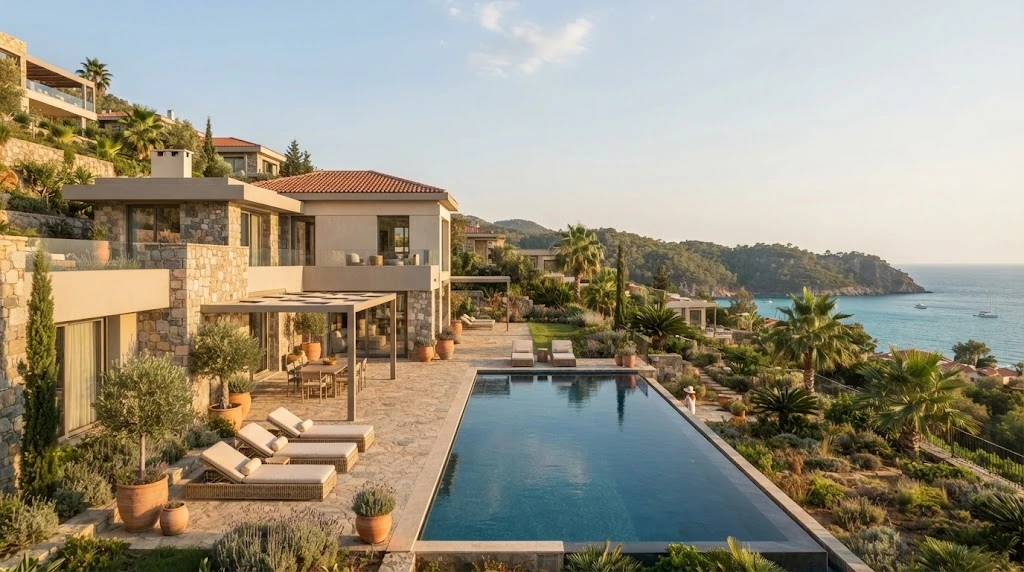
The purchase price of a villa is only the first part of the budget. Once the TAPU has been obtained, the owner pays annual tax, insurance, utility bills, and pool and garden maintenance costs, whilst also setting aside money for repairs. We at Ruyana have broken these costs down into categories so that you can compare properties based on their total cost of ownership, rather than just the price quoted in the advert.
The maintenance costs for a villa with a swimming pool in Turkey include property tax, insurance, utility bills, pool and garden maintenance, as well as repairs. A community charge may also apply within the complex. The annual budget depends on the property’s size, location, the season and the range of services included, so before purchasing, ask to see the owner’s bills, current rates and quotes from local contractors.
What does the cost of maintaining a villa in Turkey consist of?
It is useful to divide the running costs of a villa in Turkey into three categories: regular, seasonal and unforeseen. We do not include purchase costs (TAPU fees, legal fees, money transfers) or a family’s living expenses (groceries, transport) in the cost of ownership. Whilst these amounts are important for the overall budget, they are not directly related to the property itself.
The second important factor is the layout of the villa. A detached villa with a private swimming pool means that the owner is responsible for paying for all maintenance work on the pool, garden and grounds. A villa in a residential complex (site) with a communal swimming pool is organised differently: maintenance of the communal areas is paid for via the service charge, whilst the owner is responsible for their own home and plot. There is also a hybrid option: the villa is situated within a complex but has its own private swimming pool. In this case, it is important to understand who maintains the private swimming pool — the management company or the owner’s contractor.
| Cost category | Articles | Detached villa | Villa in the site complex |
|---|---|---|---|
| Regular (monthly) | Electricity, water supply, internet, pool and garden maintenance | All articles are paid for by the owner | The owner manages their own accounts; communal areas are managed via Aidat |
| Regular (annual) | Property tax, DASK, voluntary insurance, air-conditioning maintenance | Owner | Owner; insurance for common areas — as decided by the management board |
| Seasonal | Setting up and maintaining the swimming pool, watering in summer, heating in winter, pruning the garden | Owner | Private swimming pool – owner; communal swimming pool – management |
| Unforeseen | Pump breakdowns, leaks, roof repairs, boiler replacement | The owner, from the repair fund | Inside the house — the owner; communal systems — one-off contributions as decided by the meeting |
The table illustrates the principle of allocation rather than a mandatory scheme for each property. The precise division of responsibilities is set out in the complex management plan and the contracts signed by the previous owner.

How much does it cost to maintain a villa with a swimming pool?
Buyers often ask us to quote a single «average» figure. We don’t do that. The running costs of a 150 m² villa without a heated swimming pool and a 400 m² villa with a heated pool and year-round occupancy differ significantly, and giving a single figure for both would simply be misleading. There is no verified public data on the prices charged by local contractors for pool and garden maintenance that could be described as ‘market average’. Quotations from contractors for swimming pool and garden maintenance should be obtained in the form of a cost estimate for a specific property.
The table below shows details for a hypothetical property. Parameters: Antalya, villa with a gross floor area of 200 m², private unheated swimming pool measuring 8 × 4 m; the owner lives in the property for 5 months of the year. Data verified in October 2026. Amounts are shown only where there is an official formula; the tax value of 5,000,000 TRY is a hypothetical assumption. The remaining entries require an invoice or a cost estimate. An illustrative monthly scenario with a total sum is provided below, in the section on the annual budget.
| Article | Type | Guideline as at October 2026 | TRY per month | TRY per year |
|---|---|---|---|---|
| Property Tax | Compulsory | Tax value × 0.2% (for example: 5,000,000 TRY) | ≈ 833 (average, payable in two instalments) | 10 000 |
| Contribution towards the preservation of cultural heritage sites | Mandatory, if charged | 10%: tax charged in accordance with the GİB guidance | ≈ 83 (average) | 1 000 |
| DASK | Compulsory | The premium depends on the risk zone, the type of building and the floor area | Under the policy | Under the policy |
| Electricity | Consumption | Tariff based on the supplier’s contract and the customer’s category | According to the accounts | According to the accounts |
| Water supply and sewerage | Consumption | Local water utility charges | According to the accounts | According to the accounts |
| Swimming pool maintenance | Contractual | Contractor’s quotation | According to the estimate | According to the estimate |
| Gardening and watering | Contractual | Gardener’s estimate | According to the estimate | According to the estimate |
| Provision for repairs | Planned | The owner’s decision | Annual total / 12 | Plan total |
We show mandatory payments (tax and DASK) and contractual expenses (swimming pool, garden, security) separately. Mandatory payments are not dependent on whether you live in the property or not. Contractual expenses can be adjusted if you change the contractor or the scope of work.
Seasonal factors have a significant impact on bills. In summer, electricity consumption rises due to air conditioning and the swimming pool pump, as does water consumption for watering the garden and topping up the pool. In winter, electricity is used for heating if the house is not connected to the gas mains, whilst work on the pool becomes less frequent. The average monthly cost of maintaining the villa is not the same as the bill for any given month: in July, the bill may be several times higher than in February. We recommend that customers check in advance how the previous owner’s bills are broken down by month, rather than just the total for the year.
Ayad: what is included in the costs of a villa
Aidat (aidat) is a regular contribution made by the owner towards the upkeep of the communal property of a residential complex. For a detached villa, the aidat is not charged automatically: the fee is only payable if the villa forms part of a complex under joint management or if such an obligation is set out in writing. Therefore, the phrase «a villa without an aidat» needs to be verified by checking the documents, rather than relying on the seller’s word.
What is usually paid for via Aidat within the site complex:
- cleaning and lighting of communal areas, roads and car parks;
- maintenance of the communal swimming pool: chemicals, specialist services, and the electricity supply for the communal swimming pool’s pumps;
- maintaining the communal garden and watering the communal lawns;
- security, barrier, CCTV;
- the work of the management company or the complex manager;
- insurance and repairs to communal services — where provided for in the management budget.
Items not usually included in the aidat and charged for separately:
- a private swimming pool on the villa’s grounds — unless otherwise specified in the management plan;
- a private garden within the plot;
- electricity and water supply to the villa itself, metered individually;
- one-off contributions towards major repairs, as decided by the general meeting;
- debts incurred by the previous owner, if these have not been settled prior to the transaction.
Which documents need to be compared in order to determine the actual AIDAT:
- management plan (yönetim planı) — this sets out how general expenses are shared amongst the owners;
- the department’s current budget for the present year and the decisions of the most recent meeting;
- receipts for the payment of the aidat for the last 12 months;
- a certificate from the management company confirming that there are no outstanding debts;
- a contract for the maintenance of a private swimming pool and garden, if applicable.
Double counting is a common mistake when drawing up a budget. If the service charge already includes maintenance of the garden and your swimming pool, then a separate quote from a gardener or pool maintenance contractor within the same budget means that one service has been counted twice. The reverse situation also occurs: the buyer assumes that the private swimming pool is maintained as part of the complex’s services, only to then receive a separate invoice from the contractor.
In the Ruyana team’s experience, the most reliable way to avoid double-counting is to list each service on a separate line and specify next to it who is paying for it: the agent, a separate contract, or the owner themselves. If there are two payers listed on the same line, you should raise this issue with the management company before paying the deposit.
Swimming pool maintenance: labour, water and electricity
Pool maintenance at a villa in Turkey is often quoted as a single figure, such as «monthly pool maintenance». This figure encompasses various costs: the specialist’s labour, chemicals, electricity, water and repairs. To compare quotes from contractors, each item needs to be listed separately.
| Article | What’s included | What determines the cost? | How is payment made? |
|---|---|---|---|
| Cleaning | Collecting rubbish, cleaning the bottom and walls, the waterline and the skimmers | Pool size, frequency of visits, trees nearby | Contractor’s Agreement |
| Water chemistry and monitoring | Chlorine or salt, pH adjuster, algaecide, test kits | Water volume, temperature, intensity of use | Included in the contract or charged separately |
| The role of a specialist | Visits, filter flushing, equipment checks | Number of visits per month, per season | Contractor’s Agreement |
| Filter and pump | Pump operation, replacing the sand or cartridge | Pump capacity, operating hours, age of the equipment | Electricity is included in the villa’s bill; consumables are charged as used |
| Top up with water | Compensation for evaporation and wash-offs | Heat, wind, availability of shelter | On the water bill |
| Seasonal work | Spring start-up, autumn winterisation | The condition of the swimming pool after the off-season | One-off payment in accordance with the estimate |
| Heating | Heat pump, electric or solar heating | System type, water temperature, months of operation | Electricity or gas — in the overall bills |
| Repairs | Pump, leaks, tiles, lighting, automation | The age of the swimming pool, the quality of the installation | From the maintenance reserve |
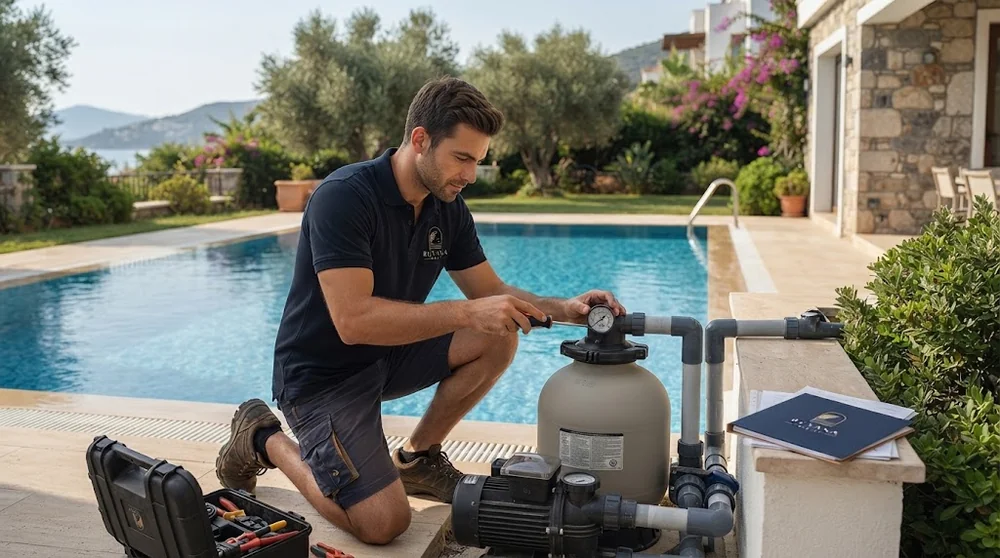
The pump’s electricity consumption is the easiest item to calculate. The formula is simple: power × hours of operation per day × number of days. Example: a 1 kW pump × 8 hours a day × 30 days = 240 kWh a month. The actual operating hours of the pump are set by the contractor, and in summer they are usually longer than in winter.
We have deliberately chosen not to convert the cost of these 240 kWh into lira. As of 2026, the EPDK has set an annual consumption threshold of 4,000 kWh or more for residential properties: customers with this level of consumption may be switched to the last-resort tariff (Son Kaynak Tedarik Tarifesi) without state support. The tariff change does not take effect immediately upon reaching the threshold: the procedure for application depends on the rules for the relevant billing period and the customer’s category. A villa with a swimming pool, air conditioning and electric heating may reach this threshold, so the preferential tariff may not apply to it. We recommend checking the rules of application and the current tariff with your electricity supplier and verifying them against the contract and bills for the specific villa.
The electricity used by the swimming pool pump is included in the budget once: either as part of the villa’s overall electricity bill or as a separate item. This also applies to the underfloor heating, which is also metered via the main meter.
Utility bills, the garden and villa repairs
Utility bills for a villa may be higher than those for a comparable flat, due to its size and the building’s technical systems. Electricity and water rates are set by the regulator and local suppliers, so the same villa in different towns will incur different bills. Main items:
- Air conditioning and heating. In summer, air conditioning units account for the bulk of the electricity bill. In winter, homes are heated using gas, if available, or electricity (air conditioning units, underfloor heating, space heaters). The type of heating system has a significant impact on winter bills.
- Water and sewerage. The bill is issued by the local water authority. The water bill usually includes charges for sewerage and municipal fees, such as the refuse collection charge. If the villa has a septic tank rather than a mains sewerage system, a septic tank emptying charge is added.
- Watering. In summer, watering the garden and lawn can account for a significant proportion of your water bill. Automatic watering saves the gardener a lot of work, but requires the system to be checked and drippers to be repaired.
- Garden. Lawn mowing, tree pruning, fertilising, pest control. The scope of work depends on the size of the plot and the plants.
- Internet and TV. The provider’s monthly charge. An internet connection is required all year round for remote monitoring via cameras.
- Security and alarm systems. The security company’s subscription fee, provided the alarm system is connected to the control centre.
- Maintenance of building services. Annual cleaning of air conditioning units, and inspection of the boiler, solar collector, pumping station and electrical distribution board.
A separate line item in the budget should be set aside for repairs. A maintenance fund is the amount that the owner plans to set aside each year for future repairs and home improvements; it is not an actual expenditure, nor is it a mandatory fixed percentage of the villa’s price. The size of the reserve depends on the age of the property, the quality of the build and the fittings. For a new villa covered by the developer’s guarantee, the reserve may be smaller; for a villa over 10 years old, it may be larger. We recommend that clients draw up a list of expensive components (pump, air conditioning units, boiler, roofing, waterproofing) and ask the contractor about their expected lifespan and replacement cost. On this basis, the contingency fund becomes a calculated figure rather than a guess.
Villa tax and DASK insurance
Property tax in Turkey is known as Emlak Vergisi. It is levied by the local council (belediye) within whose boundaries the villa is situated. Property tax on a villa in Turkey is calculated on the basis of the taxable value (vergi değeri), which is determined by the local authority in accordance with established rules, rather than on the basis of the market purchase price. The tax value is usually lower than the market price, but only the valuation for a specific property will reveal the exact figure.
The rates are set out in Law No. 1319 on Emlak Vergisi; the text of the law is available at the official Turkish legislation portal. As of October 2026, the tax rate for residential buildings (mesken) is 0.1% of the taxable value. Within the boundaries of a metropolitan municipality (büyükşehir belediyesi) and its adjacent areas (mücavir alan), the rates are increased by 100%; that is, the rate for residential properties is 0.2%. Antalya, Mersin, Istanbul and the province of Muğla, which includes Bodrum and Fethiye, have the status of a metropolitan municipality; therefore, a rate of 0.2% is generally applied to villas in these areas. The applicable rate for a specific address is confirmed by the local council; general guidance is published by The Turkish Tax Authority (GİB).
A contribution towards the preservation of cultural heritage sites (kültür varlıklarını koruma katkı payı) may be charged alongside the tax. According to a clarification from the GİB, as of October 2026, this amounts to 10% of the tax charged. The local authority’s tax assessment will indicate whether this contribution and any other charges apply to a specific property.
Illustrative calculation: taxable value of 5,000,000 TRY × 0.2% = 10,000 TRY in tax per year; 10% contribution on the tax, if applicable, = 1,000 TRY; total 11,000 TRY. This is an example of a formula, not a tax assessment for an actual villa of that value.
The tax is paid in two equal instalments. As of 2026, the first instalment is payable from 1 March to 31 May, and the second in November, by 30 November. The new owner’s obligation to pay the tax begins in the year following the year of purchase; the tax for the year of the transaction remains the seller’s responsibility. The buyer submits a notification (bildirim) to the local authority. This is usually submitted by the end of the year of purchase. If the purchase took place in the last three months of the year, the deadline for submission is three months from the date of purchase. Under Article 30 of the law, the seller and buyer are jointly and severally liable for any unpaid tax for the period prior to the sale; therefore, a certificate confirming there are no outstanding debts must be obtained before the transaction. We advise you to check the deadlines and procedure for submitting the notification with the local council and a tax adviser.
The second compulsory payment is DASK, compulsory earthquake insurance under Law No. 6305. DASK covers the building: the foundations, load-bearing structures, walls, roof and staircases. The policy covers damage caused by an earthquake and any resulting fire, explosion, landslide or tsunami. DASK does not cover furniture and personal effects, the value of the land, the cost of temporary accommodation or loss of rental income. A excess of 2% of the sum insured applies to any payout.
The DASK sum insured is calculated as the gross floor area multiplied by the cost per square metre for the building type, but not exceeding the set limit. The limits are indexed on a monthly basis. According to the published tariff table, as of October 2026, the maximum cover for residential property is 2,552,268 TRY, and the cost per square metre for a reinforced concrete building is 12,039 TRY. Please check the current figures on the official DASK (Doğal Afet Sigortaları Kurumu) website or with your insurance company; the actual terms and premium are set out in the policy. If the cost of rebuilding the villa exceeds the limit, the difference can be covered by voluntary earthquake insurance. Voluntary home insurance (konut sigortası) can cover fire, flooding, theft, weather-related damage and contents inside the property, provided these risks are included in the policy. Before signing, check the exclusions, limits, excesses and conditions relating to an unoccupied property or letting. You should check with the insurance company to confirm whether DASK and a voluntary policy apply to a specific villa – for example, if part of the property is not legally registered.
What costs remain when the villa is unoccupied?
Many of our clients live in the EU, the UK or the CIS countries and spend several months a year in Turkey. An empty villa continues to incur costs. Some of these costs are fixed, whilst others depend on contracts and on which appliances remain in use.
- Mandatory payments: Emlak Vergisi and DASK are not dependent on whether someone lives in the property.
- Voluntary insurance: It remains valid if you have taken it out. Check the terms and conditions of the policy: some insurers require regular inspections of an unoccupied property.
- Ayad: is charged regardless of whether you are staying there, provided the villa is part of the complex.
- Contractual minimum payments: subscription fees for internet, security and alarm systems; minimum payments under contracts with contractors.
- Swimming pool: The water needs to be monitored during the off-season as well, otherwise algae will grow and the equipment will suffer from stagnation. The pump usually runs for fewer hours, but it is not always possible to switch off the filtration system completely for a long period.
- Garden: Trees and lawns need to be watered in summer and pruned as the season requires, even if the owner is away.
- Home inspections: checking for leaks and mould, inspecting electrical installations after a thunderstorm, and checking the condition of the roof after rain.
- Electricity and water: depend on the appliances in use — the fridge, the pump, the chambers, the dehumidifier and the automatic watering system.
You shouldn’t assume that you can switch off all the equipment whilst you are away. Decisions regarding the operation of the swimming pool, watering and drainage should be made in consultation with the contractor and taking into account the local climate.
A remote management checklist for owners living abroad:
- a contract with an authorised representative or a management company, setting out the list of inspections and their frequency;
- a photo report or video report following each inspection and visit by the pool technician;
- online access to electricity and water bills to monitor unusual consumption;
- automatic payment of tax and AIDAT, or reminders of deadlines;
- cameras and leak detectors with notifications sent to your mobile phone;
- List of contacts: electrician, plumber, swimming pool engineer, gardener, security.
A common mistake we see buyers making is that they only factor in the months they’ll actually be living there when drawing up their budget. Empty months cost money too, and if there’s no one reliable to check the property, even a small leak can turn into an expensive repair.
Example of an annual budget for a villa with a swimming pool
Below are two tools for a hypothetical villa in Antalya. The first table is a calculation template: only the rows containing the official formula have been filled in; you should complete the rest based on the owner’s invoices and the contractors’ quotes. The second table is purely an illustrative month-by-month scenario: it shows how seasonality works and how the annual total is calculated. The figures in the second table are our assumptions for the purposes of demonstrating the method; they are not market prices nor an estimate of the costs for a real villa.
Example details: villa with a gross floor area of 200 m², reinforced concrete structure; private, unheated swimming pool measuring 8 × 4 m; air-conditioning for heating; the owner resides there from May to September (5 months); the villa is not part of a complex; there is no aidat; tax value of 5,000,000 TRY — a hypothetical assumption; calculation year — 2026; verification date — October 2026.
Calculation template
| Article | Formula | Source of the rate | TRY per year |
|---|---|---|---|
| Property Tax | Taxable value × 0.2% (for example, 5,000,000 × 0.002) | Act No. 1319, municipal levy | 10,000 (for example) |
| Contribution towards the preservation of cultural heritage sites | 10% of tax charged, where applicable | GİB clarification, municipal charge | 1,000 (for illustrative purposes) |
| DASK | Insured sum: 200 m² × 12,039 = 2,407,800 TRY (below the limit); premium: based on the risk zone tariff | DASK tariff, October 2026 | Policy premium: ____ |
| Voluntary insurance | The insurer’s offer | Insurance company | ____ |
| Electricity (including the pump and air conditioning units) | The total of 12 bills; the 240 kWh pump × months of operation is already included | Villa bills, contract rates | ____ |
| Water supply, sewerage, charges | The total of 12 invoices | Water utility bills | ____ |
| Swimming pool maintenance (operations and chemicals) | Cost per visit × number of visits + chemicals | Contractor’s quotation | ____ |
| Pool commissioning and maintenance | One-off jobs × 2 | Contractor’s quotation | ____ |
| Garden | Cost per visit × number of visits + materials | Gardener’s estimate | ____ |
| The Internet and security | Subscription fee × 12 | Contracts | ____ |
| Viewings in the owner’s absence | Cost of inspection × 7 months × frequency | Agreement with the manager | ____ |
| Provision for repairs | Total cost of component replacement plan / service life | The owner’s decision | ____ |
| Total for the year | The sum of all rows | — | ____ |
| On average per month | Total for the year / 12 | — | ____ |
To work out the total cost of a real villa, before paying the deposit you need to obtain: the local authority’s statement (assessed value, tax, levy and other charges), a DASK policy including the premium, a quote for voluntary insurance, 12 utility bills for electricity and water, quotes for the swimming pool and garden, contracts for internet and security services, the property manager’s proposal for inspections, and a plan for replacing key components.
An illustrative scenario by month
Scenario assumptions (notional, not market-based): tax and contribution — as per the notional calculation above, payable in two instalments in May and November; DASK premium — 4,000 TRY, voluntary insurance — 8,000 TRY, both payable in March; swimming pool maintenance — 6,000 TRY per month from May to October and 2,500 TRY from November to April; start-up in May and winterisation in November — 5,000 TRY each; gardening — 4,000 TRY from April to September and 2,000 TRY in the remaining months; internet and security — 1,500 TRY per month; property inspections — 2,000 TRY for each of the 7 months of absence; air-conditioning maintenance — 6,000 TRY in April; repair reserve — 60,000 TRY per year, i.e. 5,000 TRY per month. Electricity and water — these are indicative figures that follow a seasonal pattern: higher in summer due to air conditioning, the water pump and watering.
| Month | Electricity | Water | Swimming pool | Garden | The internet, security, inspections | Tax, insurance, servicing | Reserve | Total, TRY |
|---|---|---|---|---|---|---|---|---|
| January | 3 000 | 500 | 2 500 | 2 000 | 3 500 | — | 5 000 | 16 500 |
| February | 3 000 | 500 | 2 500 | 2 000 | 3 500 | — | 5 000 | 16 500 |
| March | 2 000 | 500 | 2 500 | 2 000 | 3 500 | 12,000 (DASK, voluntary insurance) | 5 000 | 27 500 |
| April | 1 500 | 500 | 2 500 | 4 000 | 3 500 | 6,000 (air conditioning units) | 5 000 | 23 000 |
| May | 3 000 | 1 500 | 11,000 (from launch) | 4 000 | 1 500 | 5,500 (tax and contribution) | 5 000 | 31 500 |
| June | 6 000 | 2 500 | 6 000 | 4 000 | 1 500 | — | 5 000 | 25 000 |
| July | 9 000 | 3 000 | 6 000 | 4 000 | 1 500 | — | 5 000 | 28 500 |
| August | 9 000 | 3 000 | 6 000 | 4 000 | 1 500 | — | 5 000 | 28 500 |
| September | 6 000 | 2 000 | 6 000 | 4 000 | 1 500 | — | 5 000 | 24 500 |
| October | 2 000 | 800 | 6 000 | 2 000 | 3 500 | — | 5 000 | 19 300 |
| November | 2 000 | 500 | 7,500 (including preservation) | 2 000 | 3 500 | 5,500 (tax and contribution) | 5 000 | 26 000 |
| December | 3 000 | 500 | 2 500 | 2 000 | 3 500 | — | 5 000 | 16 500 |
| Total for the year | 49 500 | 15 800 | 61 000 | 36 000 | 32 000 | 29 000 | 60 000 | 283 300 |
| On average per month | 283 300 / 12 | ≈ 23,608 | ||||||
Please note the electricity line item. The swimming pool pump is included in the overall electricity bill, so there is no separate «pump» line item in the tables — this is the rule against double counting that we mentioned earlier. Tax, insurance and the reserve are listed separately because they are different types of payment: mandatory, contractual and planned.
The scenario illustrates how seasonality works. The most expensive month is May (31,500 TRY): the first instalment of the tax coincides with the opening of the swimming pool. July and August are more expensive due to air conditioning, the pump and watering, whilst November is more expensive due to the second instalment of the tax and winterisation. The cheapest months are January, February and December (16,500 TRY). The difference between the most expensive and the cheapest month is almost double, so whilst the average monthly cost is useful for planning, it does not match the bill for any single month. We recommend keeping an amount in your lira account that covers the most expensive month, rather than the average figure.
We recommend filling in a table like this for each villa on your shortlist, replacing our estimates with actual invoices and dated quotes. Once all the rows have been calculated in the same way, it becomes clear that a property with a lower purchase price can sometimes be more expensive to maintain.
How to check the costs before buying a villa
Before paying a deposit, make sure that the maintenance costs are supported by documentation. The process is as follows:
- Bills for the past 12 months. Ask the seller for electricity, water and gas bills covering at least one year. A full year shows seasonal variations, whereas a single summer or winter month does not. Check whether the seller has lived in the property all year round.
- Tax base and accruals. Obtain your Emlak Vergisi assessment for the current year and a certificate confirming that you have no outstanding debt from the local authority. Compare the stated taxable value with your expectations.
- Valid insurance. Check your DASK policy: the validity period, the sum insured, the floor area and the type of building. If you have voluntary insurance, check the cover and whether it can be renewed.
- Documents and the department’s budget. For the villa in the complex, please request the management plan, the budget for the current year, the minutes of meetings and decisions regarding future one-off contributions.
- Debts. Check for any outstanding debts relating to the deposit, utility bills and tax. Tax debts may be passed on to the buyer by law, whilst outstanding utility bills can complicate the process of transferring utility contracts.
- Contracts with contractors. Ask to see the contracts for pool maintenance, gardening and security. Check what is included in the price and whether the contract can be terminated.
- Condition of the equipment. Book an inspection of the pump, filter, air conditioning units, water heater, roof and the swimming pool’s waterproofing. The age of the equipment determines the budget available for repairs.
- Current rates and estimates. Obtain current rates from suppliers and two or three quotes from local contractors for the same work. The quotes should be based on the same list of services so that they can be compared.
Comparing cities requires caution. We are not claiming that the cost of maintaining a villa in Bodrum is a specific percentage higher than in Alanya or Antalya: without comparable properties of the same size, with a swimming pool and similar occupancy arrangements, such a percentage proves nothing. In Alanya, Antalya, Belek, Mersin, Bodrum, Fethiye and Istanbul, water and sewage charges, municipal tax rates, the length of the hot season, the need for heating and the prices charged by local contractors all vary. The correct approach is to check the local authority rates and obtain actual quotes for the chosen property in each city.
If you’re still deciding on a town and the type of villa, it’s easier to compare properties based on their overall running costs rather than just the purchase price.
Please let us know your budget, the city and the type of accommodation you’re considering, and we’ll find some villas for which you can request quotes and estimates in advance.
This list does not replace a document check: for each villa on the list, the expenses must still be substantiated with invoices, municipal charges and contractors’ quotations.
Additional costs when letting out a villa
The costs of normal ownership and those associated with the letting business should be accounted for separately. If a villa is let to holidaymakers, the following items are added to the running costs: management company fees, cleaning between guests, laundry for bed linen and towels, consumables (toiletries, kitchen utensils), commissions to online booking platforms, and liability insurance for guests. The allocation of utility bills between the owner and the tenant depends on the tenancy agreement: in short-term rentals, electricity and water are usually the owner’s responsibility, whilst in long-term rentals, these are often paid by the tenant. Furniture also tends to wear out more quickly, whilst a swimming pool with regular guests requires more chemicals and visits from a specialist.
Short-term lettings are governed by Act No. 7464 on the letting of accommodation for tourism purposes; the Act is published in Turkey’s Official Gazette (Resmî Gazete), and the current version is available at the official Turkish legislation portal. As of October 2026, to let out accommodation for a period of up to and including 100 days per booking, you must obtain a tourist let licence (turizm amaçlı kiralama izin belgesi) in advance from the Ministry of Culture and Tourism. Applications are submitted via e-Devlet; according to the Ministry’s regulations, they are processed within 60 days. For properties in blocks of flats, a unanimous decision by the owners is required, whilst for villas within a complex, the conditions depend on the ownership structure and are therefore assessed on a case-by-case basis. The owner holding the permit is responsible for registering guests in accordance with the law on identity notification.
The law provides for administrative fines for letting without authorisation, which are imposed consecutively. According to the Ministry’s guidance, as of October 2026, the fine for a first offence is 180,617 TRY per property, and the owner is given 15 days to obtain a licence. If the breach is not rectified within this period and the letting continues, a fine of 903,088 TRY is imposed. Fine amounts are indexed annually; therefore, we recommend checking the current amounts with the Ministry of Culture and Tourism before commencing letting.
Rentals for a period exceeding 100 days for a single tenancy are not covered by Law No. 7464 and are governed by the general rules on residential tenancies. Rental income is subject to income tax, and the procedure for declaring it depends on the owner’s tax status, including whether they are a tax resident of Turkey. We do not guarantee a return on letting: occupancy rates, prices and expenses vary from season to season and depend on the specific property.
The rules governing holiday rentals have changed several times in recent years, and there are specific considerations for each villa: the type of ownership, the composition of the owners, the status of the complex, and the owner’s tax residency.
If you are planning to let out a villa and would like to find out in advance whether the property is eligible for a licence and what costs are involved, discuss your situation with the experts before you buy.
It is best to decide whether to let out a property before the transaction takes place: this decision will determine the choice of property, the insurance, the contract with the management company and the overall cost of ownership.
Frequently asked questions about villa maintenance in Turkey
How much does it cost to maintain a villa with a swimming pool in Turkey?
There is no single fixed cost for all villas: the budget depends on the town, the size of the house and the swimming pool, the tenancy arrangements and heating costs. The calculation includes tax, insurance, utility bills, the swimming pool, the garden, a maintenance reserve and any potential deposit. The calculation is based on the owner’s annual bills and quotes from local contractors.
How much does it cost to maintain a swimming pool at a villa?
The cost depends on the pool’s volume, the frequency of visits, the filtration system, the chemicals required and whether the pool is heated. Ask the contractor to itemise the labour, chemicals, seasonal start-up and winterisation separately, and clarify exactly what is included in the contract price.
Do you have to pay a deposit for a private villa in Turkey?
Service charges are not automatically levied on a detached villa. Charges apply if the property forms part of a complex under joint management or if the obligation is set out in writing. Check the management plan, budget and receipts, as well as who maintains the private swimming pool.
How is tax on a villa in Turkey calculated?
The tax is calculated on the basis of the assessed value, which is determined by the local authority, rather than the market price. As of October 2026, the rate for residential property is 0.1%, and within the boundaries of the greater municipality it is 0.2%; a surcharge of 10% may be added to the tax. It is paid in two instalments, in May and November.
What costs are incurred when the villa is unoccupied?
There are still taxes, insurance, service charges (if applicable) and payments under existing contracts to be made. The swimming pool, garden and house require regular maintenance and inspections, whilst electricity and water are consumed by the equipment in use.
What additional costs are involved in letting out a villa to holidaymakers?
Management fees, cleaning, laundry, consumables, site fees and liability insurance are added. For rentals of up to and including 100 days per booking, a licence is required under Act No. 7464. Please check the terms and conditions and tax implications with a solicitor and tax adviser before commencing the let.
Conclusion
The running costs of a villa with a swimming pool in Turkey consist of compulsory payments (Emlak Vergisi, with a possible additional contribution, and DASK), utility bills, contracted services for the swimming pool and garden, a possible service charge, and a repair fund. Mandatory payments are calculated using set formulas, whilst the other items are substantiated by invoices and cost estimates specific to the property in question.
In our view, the main risk for the buyer is an incomplete calculation: empty months or seasonal peaks may not be included in the budget, or a single service may be counted twice. Exchange rate risk should also be taken into account separately. Most expenses are quoted in lira, and rates and limits in Turkey are frequently revised, so a budget calculated in euros or dollars on the date of purchase may look very different a year later. We do not provide conversions into euros or dollars, as an amount in a foreign currency without the current exchange rate on a specific date is misleading.
The Ruyana team recommends filling in the same expenses spreadsheet for each villa on your shortlist and only making a decision once you have checked the documents. Whilst this approach takes longer before you pay the deposit, it protects you from unexpected bills after the purchase.
This material is for information purposes only and does not constitute personal legal, tax or financial advice. Rates, tariffs, limits, penalties and legal provisions are correct as at October 2026 and are subject to change; before making a decision, please check the latest information with a relevant specialist and in official sources.
 Property in Georgia
 Property in Montenegro
 Property in Cyprus
 Property in the UAE
 Property in Bali
 Property in Thailand
 Property in Spain
 Property in Saudi Arabia
 Property in Zanzibar
 +90 531 719 64 01
 hello@buy-property-turkey.com
 Summer Park Business Centre, Block 8A, No. 3, 07400 Oba, Alanya/Antalya, Turkey


 Get the catalogue of the top 7 properties