
 +90 531 719 64 01


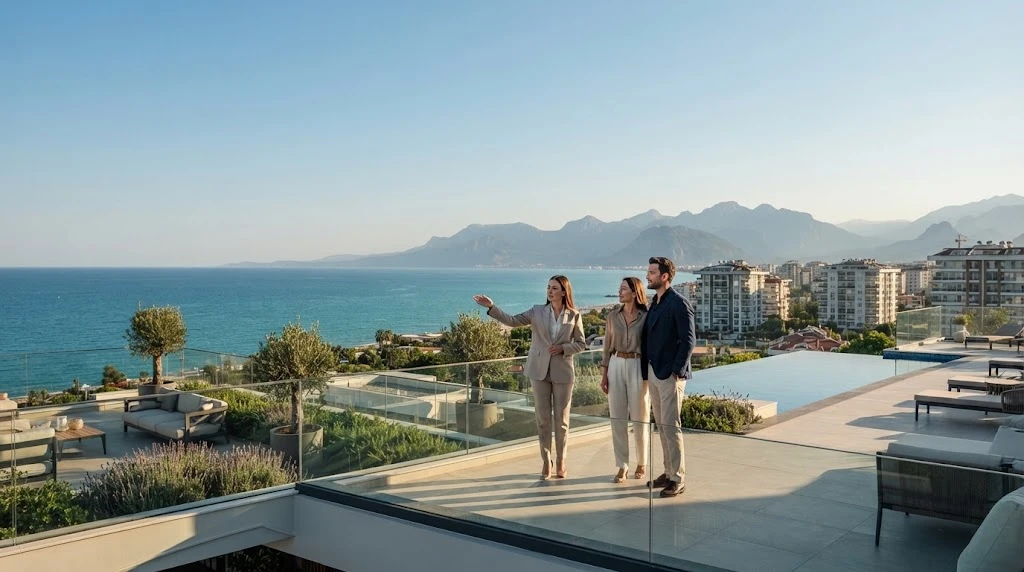
Antalya is suitable for permanent residence, winter holidays and as a second home, but the city’s advantages only really come into their own if they are accessible from your specific address. The Ruyana team has identified seven reasons why buyers choose Antalya, and for each one has highlighted a limitation and how to check it. This guide helps you compare the city with other options before choosing a flat; it is not a substitute for a site visit or a legal due diligence check.
The reasons for buying property in Antalya include the mild winters, the sea, the healthcare and education facilities, the international airport, year-round city life and the choice of accommodation. These advantages need to be assessed on a case-by-case basis: summer heat, maintenance costs, educational conditions, insurance cover and immigration restrictions may influence the decision to buy.
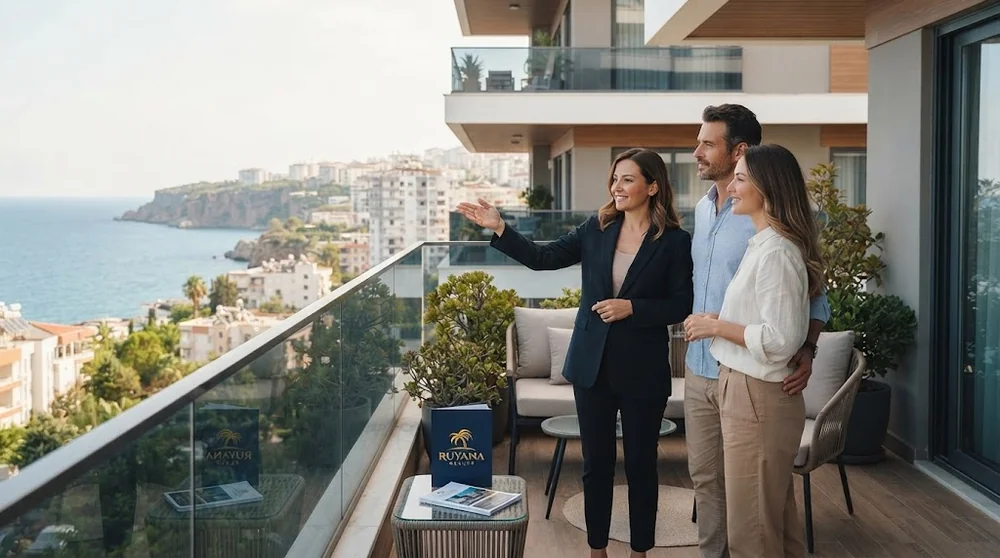
Why people choose Antalya: seven reasons in brief
The term «Antalya» is often used to refer to different areas. Antalya is both a metropolitan city and a province. The province comprises the districts of Alanya, Manavgat, Kemer and Serik; Belek is a resort area and a neighbourhood within the Serik district. This article focuses primarily on the central urban area, comprising the districts of Konyaaltı, Muratpaşa, Kepez, Aksu and Döşemealtı. Alanya and Belek lie outside this area, so their infrastructure and transport links differ.
The clients the Ruyana team works with most often cite seven reasons for choosing Antalya:
- Climate: mild winters and a long, warm season.
- The seaside and leisure: promenades, beaches and parks within the city.
- Healthcare: public and private clinics specialising in various fields.
- Education: state, private and international schools.
- Airport and transport: the international airport and the city’s rail network.
- A year-round urban environment: shops, markets and services are open all year round.
- Choosing a home to suit different scenarios: from a flat by the sea to a house with a garden.
Every advantage has its downside. The table below helps you quickly work out who this is relevant to and what you need to check before paying a deposit.
| Reason | Who can benefit from it | Restriction | What to check |
|---|---|---|---|
| Climate | Pensioners, families and shoppers spending the winter here | A hot summer, damp winter | Window orientation, air conditioning, signs of damp |
| The sea and holidays | Families with children, active people | Noise, seasonal traffic volumes, crossing motorways | The actual walking route from the building entrance |
| Medicine | Pensioners and people with chronic illnesses | Payment, insurance cover, language | Policy terms and conditions and booking an appointment with the relevant doctor |
| Education | Families with school-age children | Admission, venues, language, cost | School status, documents, route |
| Airport and transport | For frequent flyers | Seasonal flights, traffic jams | Timetable for the required journey and route from home |
| Urban environment | For those who live there all year round | Part of the business operates on a seasonal basis | Shop and service opening hours in winter |
| Choosing a home | Shoppers with different budgets | Maintenance costs, building status | TAPU, Iskhan, Aidat, technical condition |
1. Antalya’s climate and life in winter
The climate is the most common reason why buyers from Europe, the UK and the CIS countries are considering Antalya. According to data from the Turkish General Directorate of Meteorology (MGM), The average monthly temperature in Antalya is 10.1 °C in January and 28.6 °C in July; these are long-term averages for the period 1930–2025. According to the same MGM data, the average maximum temperature in July is 34.2 °C. These figures represent the long-term average. They are not a forecast for a specific year and do not indicate the absolute maximum: on certain days in summer, the temperature can be significantly higher than the average maximum.
Summer and air conditioning
In Antalya, it is hot for several months running in the summer, and air conditioning in a flat becomes a necessity rather than a luxury. Electricity bills usually rise in the summer, and this increase needs to be factored into your budget. A flat with south- or west-facing windows without any shading will heat up more. A flat on the top floor beneath a flat roof without insulation may also require the air conditioning to run constantly. For older buyers and families with young children, the summer heat is a key factor that needs to be checked in person, rather than relying on a description.
Winter, humidity and heating
A mild winter does not necessarily mean a dry and warm flat. It rains in Antalya during the winter, and humidity in rooms without proper ventilation can lead to condensation and mould. Many flats are heated by air conditioning, whilst some buildings are connected to the gas mains. The quality of the windows, wall insulation and the heating system have a greater impact on comfort than the temperature outside. A common mistake we see buyers making is viewing a flat only in summer, when signs of damp are not noticeable.
When carrying out an inspection, we recommend that customers check the following in advance:
- the orientation of the windows and the presence of shading, balconies or blinds;
- traces of mould in the corners, behind furniture, on window sills and in the bathroom;
- the type and condition of the windows, and whether there is ventilation and an extractor fan;
- heating system, number and age of air-conditioning units;
- Insulation of the roof and façade, particularly on the upper floors.
We do not recommend considering Antalya’s climate as beneficial for any medical condition. Humidity and heat affect people in different ways, so if you have a chronic condition, it is best to discuss the climate with your doctor before moving there.
2. The seaside and leisure activities close to home
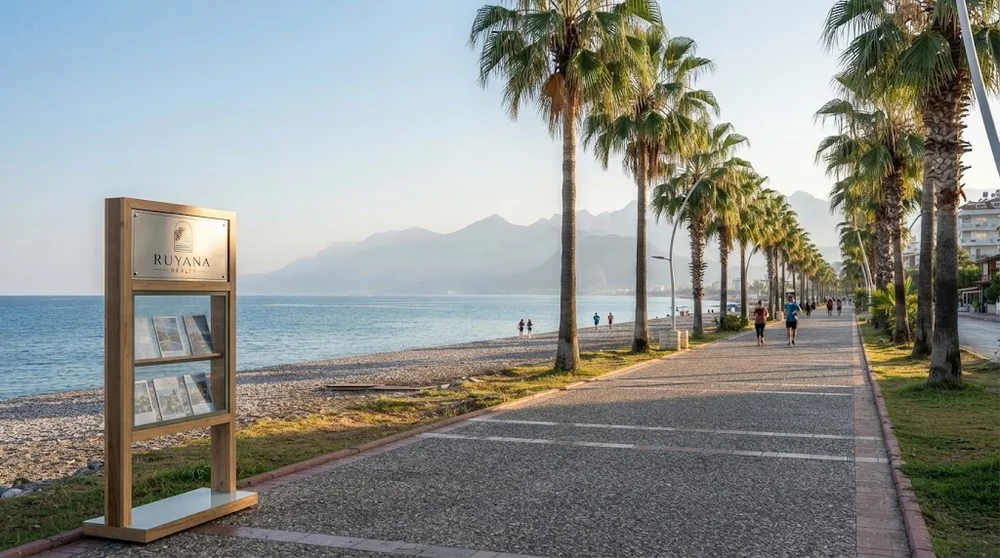
The sea in Antalya is part of everyday life, not just a holiday attraction. Konyaaltı is known for its long pebble beach and promenade with footpaths and cycle paths, whilst the eastern part of the town, in the Lara area, features sandy stretches of beach. The town has parks, promenades along the cliffs in Muratpaşa and green spaces along the coast. For families and pensioners, regular walks by the sea are often one of the main reasons for buying a property.
The name of the neighbourhood does not guarantee walking access to the beach. The Konyaaltı neighbourhood extends a long way inland from the coast, and a flat with an address in Konyaaltı may be several kilometres from the sea. The same applies to Lara: this is a general term for the area, rather than a precise address right by the water. There may be busy roads, a steep descent or a stretch without a pavement between the building and the beach.
The process goes like this: you walk from your front door to the sea at your usual time, count the number of times you have to cross the road, and assess the gradient and the lighting in the evening. In summer, it’s worth checking how busy the beach and car parks are, and at night – the noise from cafés and roads. Safe crossings and pavements are important for children. For people with reduced mobility, you should check for ramps, steps and the availability of accessible access points to the water.
In the Ruyana team’s experience, buyers tend to overestimate the value of a sea view and underestimate the importance of the daily journey to the water. A sea view usually increases a property’s price, whilst the route to the water determines how often you’ll actually go down to it. An apartment a 15-minute walk away along a flat street and one a 7-minute walk across a multi-lane road offer very different living experiences.
3. Healthcare: choice of clinics and access conditions
Antalya is home to public hospitals, a university hospital, private medical centres and dental practices. Antalya City Hospital — part of the Turkish Ministry of Health’s network — is a prime example of the city’s large-scale public healthcare infrastructure. The fact that there is a hospital in the city does not necessarily mean that treatment there will be available to you on favourable terms. It is important for foreign buyers to distinguish between several different issues.
- Availability of a facility: whether there is a clinic in the town specialising in the relevant field.
- Note: how quickly you can see the right specialist.
- Entitlement to treatment: the conditions under which patients with your status are admitted.
- Payment: how much does the service cost without insurance?.
- Insurance cover: does your policy cover this service at this clinic?.
- Language: Can the consultation be conducted in a language you understand, or do you need an interpreter?.
State and private aid
Foreign nationals may seek treatment at public healthcare facilities in Turkey, but the payment arrangements depend on the patient’s status, whether they have public or private insurance, and the type of service provided. Ownership of a flat in Antalya does not, in itself, entitle you to free medical treatment. Private clinics are often chosen for their quick appointment booking and the option to communicate in English, but you should check the cost of consultations and tests in advance. Not every clinic has a Russian-speaking doctor, and their availability cannot be guaranteed as a matter of course. If you need a regular specialist, such as an endocrinologist or a cardiologist, check the specific doctor and the journey time from your home to the clinic.
What to check in your insurance policy
Health insurance is usually required to apply for a residence permit (ikamet), but a policy that is sufficient for the application may offer limited cover. You should not assume that any policy taken out for the purpose of obtaining a residence permit will cover routine treatment or expensive procedures. We recommend that clients ask their insurer the following questions:
- Are chronic and pre-existing conditions covered, and from when?
- What exclusions and limits are set out in the contract?
- At which clinics in Antalya is the insurance policy valid, and is prior authorisation required?
- Are outpatient appointments, tests and medicines covered, or is it only inpatient care?
- Are there any age restrictions, and how does the price change when renewing?
An flat near a large hospital is only useful if you can actually afford to pay for treatment at that hospital.
4. Education: school before choosing a flat
For families with children, choosing a school should come before choosing a flat. In the Ruyana team’s experience, parents often start by finding a housing complex with a swimming pool, only to realise later that the right school is in another part of town or has no places available. The existence of schools in Antalya does not guarantee that a particular child will be admitted to a particular school.
State, private and international schools
In Antalya, there are state schools run under the supervision of the Turkish Ministry of National Education (MEB), private Turkish schools and schools offering international curricula. In state schools, lessons are taught in Turkish, and a child who does not speak the language will need a period of adjustment and extra support. Private schools vary in terms of their curriculum, the proportion of lessons taught in foreign languages, admission requirements and fees. International programmes are usually more expensive, and places are limited.
When comparing schools, you should clarify the language of instruction, admission requirements, the availability of places in the relevant year group, the rules governing allocation based on address, and the costs of tuition, meals, teaching materials and school transport. The annual budget for a private school consists of several payments, so do ask for a full list of costs in writing. We do not list the fees for specific schools, as these change every academic year and depend on the year group.
Russian-language educational centres are a separate matter. A centre for further education or a club operating in Russian cannot be considered a licensed school without checking its status with the Ministry of National Education (MEB). If you are considering this option, please check whether the institution issues educational qualifications that are recognised in Turkey and in your home country.
Documents and e-Denklik
If a child has been educated abroad, they may need to undergo a process to recognise the equivalence of their education — denklik — when transferring to a Turkish school. The Turkish Ministry of National Education’s e-Denklik system is used to apply for the recognition of school education completed abroad. A decision on denklik confirms that the standard of education is equivalent, but does not guarantee admission to the chosen school: admission depends on the school’s rules and the availability of places.
We recommend that clients prepare a standard set of documents in advance:
- the child’s passport and the parents’ passports;
- The child’s residence permit (ikamet) or confirmation of application and foreigner identification number (yabancı kimlik numarası);
- birth certificate;
- academic records from previous years — report cards, a certificate from the school — translated into Turkish;
- an apostille or consular legalisation of documents — depending on the country of issue;
- a decision on denklik, if required for the relevant class;
- proof of your address and details of your vaccinations, if requested by the school.
The exact list and translation requirements should be checked with the chosen school and the district education office (İlçe Milli Eğitim Müdürlüğü) as at the current academic year.
The process is as follows: choose the type of school, confirm its status and curriculum, gather the necessary documents and, if required, undergo a denklik assessment, secure a place, check the route from your future home, and only then choose a flat. It is best to drive the route in the morning on a school day, when traffic is at its heaviest.
5. The airport and transport for regular journeys
For owners of second homes and people who frequently fly to visit their families, the airport is one of the main reasons for choosing central Antalya. Antalya Airport is an international airport situated within the Antalya metropolitan area, offering regular and seasonal flights to many countries. The proximity of the airport gives it an advantage over the province’s more remote resorts. By way of comparison, the journey from Alanya to Antalya Airport takes considerably longer than from areas within the city centre.
Whether there is an airport and whether there is a suitable flight are two different matters. Many international routes operate mainly in the summer, whilst in winter the number of direct flights to a number of cities is reduced. If you’re planning to live in Antalya in winter and fly home, check the winter timetable for your chosen route with the airlines and the airport operator.
The journey time to the airport depends on your specific location. We do not quote a standard transfer time: the journey from the eastern part of Lara differs from that from the western part of Konyaaltı, and the journey takes longer during rush hour and in the summer season. The city has AntRay, a rail transport system, as well as bus routes. AntRay is convenient if your property is located near a stop, but many areas, particularly Döşemealtı and parts of Aksu, rely on cars for day-to-day travel.
Before buying, we recommend checking the journey to the airport during rush hour and at night, the number of changes required on public transport, the availability of parking near the property, and the noise from take-offs and landings. Flat near the airport are convenient for travelling, but some of them are situated under the flight path. It is best to assess the noise levels in person at different times of the day.
6. Year-round urban infrastructure
Central Antalya is a large city where life carries on even after the tourist season has ended. Supermarkets, markets, chemists, banks, local services, gyms and shopping centres are open all year round. Weekly local markets provide access to seasonal produce. Parks, promenades and public spaces are used by local residents even in winter. The fact that central Antalya is a year-round destination sets it apart from smaller resorts, where a significant proportion of businesses close down in winter.
The town is open all year round, but some businesses are seasonal. Beach cafés, some restaurants in tourist areas and certain services for holidaymakers close or reduce their opening hours in winter. In the tourist areas of Lara and Konyaaltı, winter is quieter than in the residential neighbourhoods of Muratpaşa and Kepez.
It takes time to settle in. Some shops, clinics and agencies offer services in Russian or English, but this is not the case everywhere; in government offices, the main language is Turkish. A residence permit for property owners does not entitle the holder to work in Turkey: a separate work permit is required. Buyers who plan to work locally should check this matter separately.
We recommend a trial stay during the winter. Here’s a hypothetical example: a family rents a flat in their chosen neighbourhood for one or two months between December and February, goes shopping, visits the school or clinic, and checks that the necessary services are working properly and assesses the condition of the property during the rainy season. After such a trial period, the decision to buy is based on real-life experience rather than impressions from a summer holiday.
7. Choosing a property for different purposes
The seventh reason is the variety of neighbourhoods and property types. In central Antalya, you can find a flat in a densely built-up urban area, an apartment in a complex with a swimming pool, or a house with a garden. A diverse range of properties means you can find a home that suits your needs, rather than being proof of future price rises.
The central urban area comprises five districts: Konyaaltı, Muratpaşa, Kepez, Aksu and Döşemealtı. Lara is a common name for the coastal area to the east of the city, which mainly falls within the Muratpaşa district; part of the eastern coastline extends into Aksu. Altıntaş is a neighbourhood (mahalle) in the Aksu district, which is often mentioned in advertisements for new-build properties. The table below summarises the Ruyana team’s general observations. Conditions can vary significantly between different streets within a single district, so the table is not a substitute for assessing a specific address.
| District or area | Everyday scenario | What to check nearby | Transport | Features of the fund | Restrictions |
|---|---|---|---|---|---|
| Konyaaltı | Life by the sea, walks along the seafront | Distance to the beach, schools and supermarkets | Buses and rail services in part of the district | Estates of various ages, new-build developments | Summer visitor numbers; the area extends inland from the sea |
| Muratpaşa and Lara | City life, amenities, the east coast | Clinics, schools, the noise from the motorways | A well-developed network, rail transport, and proximity to the airport for the eastern part | Dense development, plenty of second-hand properties | Noise, parking, some of the buildings are old |
| Kepez | Everyday city life away from the sea | Schools, markets, route to the city centre | Rail services and buses on a number of routes | Block of flats, residential estates | Distance from the sea, variation in neighbourhoods |
| Aksu and Altyntaş | New developments, proximity to the airport | Readiness of schools, shops and clinics | It depends largely on the car | A significant proportion of new-build properties | Infrastructure in a number of neighbourhoods is still under development; aircraft noise |
| Dyoshemealty | A house with a plot of land, in a peaceful setting | Schools, clinics, the road into town | High dependence on cars | Villas, low-rise houses | Travel time, fewer services nearby |
The type of property has just as much of an impact on risks and costs as the neighbourhood. Buying a second-hand property allows you to assess the actual condition of the house, the neighbours and how well the management works, but requires you to check the age of the building, any outstanding issues, the need for repairs and any outstanding maintenance charges. A new-build offers a modern layout and often the infrastructure of a residential complex, but when buying off-plan, you need to check planning permission, completion dates, the readiness of surrounding roads and schools, as well as the actual amount of future service charges. A villa offers space and privacy, but the costs of maintaining the plot, the swimming pool and any repairs fall on the owner, and everyday life almost always requires a car.
We do not provide average prices by district: without a date, methodology or comparable properties, such figures are misleading. When comparing prices, use properties that are similar in terms of floor area, age of the building, floor level and distance to the sea, and distinguish between the asking price in the advert and the actual transaction price.
Costs and restrictions before purchasing
The decision to buy is based on the total cost of ownership, the legal status of the property and a separate assessment of the right of residence. The price quoted in the advert is merely the first step in the calculation.
Full budget
Tax, duty and fee rates in Turkey are subject to change; therefore, we list the expense items without specifying exact percentages. The current rates, as at October 2026 and on the date of your transaction, must be confirmed with an independent solicitor and via official sources, such as the Turkish Tax Administration (GİB). If you are calculating your budget in euros or US dollars, bear in mind the exchange rate risk: costs in Turkish lira may vary significantly when converted. Official exchange rates are published by the Central Bank of Turkey (tcmb.gov.tr).
| Expenditure item | When it happens | What needs clarifying? |
|---|---|---|
| Purchase price | In a transaction | Comparable properties, payment terms, contract currency |
| Registration of the TAPU | When registering | Current duties and charges, and their allocation between the parties |
| Legal assistance | Before and during the transaction | Scope of verification, translation and notarial services |
| Valuation | Before registering | Relevant requirements for the valuation process for a foreign buyer |
| DASK | Before registration and annually | A valid compulsory earthquake insurance policy |
| Voluntary home insurance | After purchase, if you wish | Coverage for contents, property, fire, water damage and theft |
| Health insurance policy | For a residence permit and annually | Coverage, exclusions, clinics, age restrictions |
| Renovations and furniture | After purchase | Condition of the flat, air conditioning, windows |
| Ayadat | Every month | The amount of the service charge, what is included, and the previous owner’s outstanding debts |
| Utility services | Every month | Electricity in the summer, water, gas, internet |
| Taxes | Annually and upon sale | Property tax, tax on letting or sale |
| School | Every year | Tuition, meals, transport, materials |
| Transport | Regularly | Car, parking, airport transfers |
Three different types of insurance: DASK, home and health
Buyers often confuse these three policies, even though they serve different purposes. DASK is compulsory earthquake insurance for residential property; a valid DASK policy is usually required for transactions involving the land registry and when connecting water and electricity supplies. It covers damage to the building caused by an earthquake up to a set limit, but does not protect fittings, furniture and personal property against other risks. Voluntary home insurance (konut sigortası) is taken out at the owner’s discretion and may cover fire, flooding, theft and damage to property — the scope of cover depends on the policy. A health insurance policy is not linked to the flat: it is required for applying for a residence permit and for covering medical treatment costs. Having DASK does not replace health insurance, and a health insurance policy does not cover the flat.
TAPU and technical inspection
A TAPU is a certificate of ownership of property in Turkey, which is registered with the General Directorate of Land Registry (TKGM). Using data from the TKGM, you can check the owner, the type of property and any records of restrictions; official information on the procedures is available on the website tkgm.gov.tr. An ‘iskan’ is a certificate authorising a building to be put into use; having one is essential for connecting to utility services, assessing the legality of the building and a number of further procedures. A flat without an ‘iskan’, or where the actual layout does not match the plans, carries additional risks.
The process is as follows: selection of the property, verification of the seller and the representative’s authority, checking for encumbrances (mortgages, seizures, restrictions), verification of the title deed and compliance with the development plan, valuation in accordance with applicable requirements, followed by registration with TAPU. According to Turkey’s official investment guide (invest.gov.tr) Foreign nationals may purchase property subject to the restrictions laid down by law; however, eligibility to purchase depends on their nationality and the location of the property. This is therefore checked on a case-by-case basis for each buyer. It is best to have the technical condition of the building – including its structure, roof, dampness and building services – assessed by an independent specialist. Before paying a deposit, ensure that the legal and technical checks have been completed and that their results have been recorded in writing.
Residence permits and tenancy
Buying property in Antalya does not automatically entitle you to a residence permit. Home ownership may constitute grounds for applying for a short-term residence permit (ikamet), which is processed by the Turkish Directorate General of Migration Management (Göç İdaresi). According to the official list of documents issued by Göç İdaresi, as of October 2026, the value of the property for this purpose must be at least US$200,000, equivalent in Turkish lira at the date of purchase. The threshold applies to the date of purchase: for properties purchased earlier, and in transitional cases, the conditions may differ, so these are assessed on a case-by-case basis. Meeting the threshold does not guarantee the granting of a residence permit: the decision also depends on the address, the applicant’s documents and the circumstances of family members. In a number of neighbourhoods, there are location-specific restrictions on the registration of foreign nationals. The current rules are published on the page about short-term residence permits on the official website goc.gov.tr; they must be checked before the deposit is paid, not after the TAPU has been registered.
If you’d like to discuss your situation regarding your residence permit and choosing a neighbourhood, please message the Ruyana team on WhatsApp: we can respond in Russian and English.
Rental terms are agreed separately. Law No. 7464 was enacted on 25 October 2023; the provisions on tourist accommodation rentals have been in force since 1 January 2024. To let accommodation for a period of up to and including 100 days under a single contract, a tourist let licence is required, which is issued by the Turkish Ministry of Culture and Tourism. (as at October 2026). For flats in blocks of flats, the law requires the consent of the other owners; the precise procedure for obtaining consent, the requirements relating to the building and the tax obligations should be checked against the current version of the law in the official legislation database mevzuat.gov.tr. The fact that the area is popular with tourists does not prove that short-term letting of a specific flat is permitted, nor does it prove its profitability. Long-term letting also requires consideration of tax implications and the terms of the tenancy agreement.
How to find out if Antalya is right for you
It takes time to check everything, but it protects you from making a purchase that doesn’t suit your lifestyle. The steps below are suitable for families, pensioners and second-home owners; the only difference is the focus.
- Decide on your scenario. Permanent residence, a winter retreat or a second home each call for different areas and types of accommodation. For a family, schools are important; for a pensioner, healthcare and a straightforward journey are key; and for a second-home owner, proximity to the airport and ease of managing the property are essential.
- Check whether you are eligible to purchase property and reside there. Find out about any restrictions applicable to your nationality, residence conditions, address restrictions and the requirement for health insurance.
- Choose a school or a healthcare option. For families: confirmation of a place at school and the relevant documents; for pensioners: a clinic, a specialist and the terms of the policy.
- Check out the neighbourhood. Spend some time in a rented flat in both summer and winter, walk the routes to the sea, the school, the surgery and the shops, and assess the noise levels and transport links.
- Work out your budget. Take into account all the expenditure items from the table above, including start-up costs, repairs and exchange rate risk.
- Carry out an independent inspection before paying the deposit. A solicitor checks the property registration certificate, any encumbrances, the seller and any claims; a surveyor checks the condition of the building and the flat.
There are situations where it is worth putting a deal on hold. Reasons for putting a deal on hold include: an unclear status regarding the address for registering foreign nationals; an unconfirmed school or a lack of places; insurance that does not cover the necessary medical treatment; unclear costs, including an ambiguous deposit or outstanding debts; missing documents — such as a certificate of no objection, confirmation of the seller’s authority, or the flat’s floor plan. A common mistake we see buyers make is paying a deposit under pressure to secure the «last flat» before the due diligence process is complete. Pausing the process for a few days works out cheaper than rectifying a mistake after registration.
To quickly work out which area and type of property best suits your situation, take this short quiz consisting of a few questions about your budget, household composition and how long you plan to stay.
The test results are no substitute for a consultation, but they do help to narrow down your choice to two or three areas before you start viewing properties.
Frequently asked questions about property in Antalya
Is it worth buying a flat in Antalya as a permanent home?
Antalya is worth considering if you’re happy with hot summers, a bustling city life and the cost of living in your chosen neighbourhood. Before buying, it’s a good idea to rent a property here for a while to check what the property is like in winter and to familiarise yourself with your daily commute. The decision depends on your budget, your legal residency status, access to healthcare and schools; proximity to the sea and the appeal of the development are secondary considerations here.
Which area of Antalya should you choose to live in with children?
Families choose a neighbourhood after checking the school, the language of instruction and the daily commute. Compare specific addresses in Konyaaltı, Muratpaşa, Kepez and other suitable neighbourhoods in terms of transport, parks, healthcare and living costs. The name of the neighbourhood does not guarantee proximity to a school or a place at it: admission criteria and availability of places must be confirmed before a deposit is paid.
Is a residence permit granted when buying property in Antalya?
Buying property does not automatically entitle you to a residence permit. Ownership of suitable accommodation may form the basis of an application. According to the official list of documents from the Göç İdaresi, as of October 2026, the value of the property must be at least 200,000 US dollars, converted into Turkish lira at the exchange rate on the date of purchase; for earlier purchases, the conditions are assessed on a case-by-case basis. Even if the threshold is met, the decision depends on the applicant’s address, documents and circumstances. The current rules can be clarified with the Göç İdaresi and an independent immigration specialist.
Can foreign nationals receive treatment at state hospitals in Antalya?
Foreign nationals may seek treatment at state-run healthcare facilities, but the payment arrangements and insurance reimbursement depend on the patient’s status, their cover and the specific service provided. Owning a flat does not make treatment free of charge. Check in advance the booking conditions, the documents required, the cost and whether your policy covers the treatment. For chronic conditions, check separately for any exclusions and the availability of the specialist you need.
How do I enrol my child at a school in Antalya?
First, select the type of school and check the admission requirements, language requirements, address and the documents required for your child: passport, residence permit, and educational documents with translations and legalisation. For education completed abroad, a ‘denklik’ procedure via the MEB system may be required. Then confirm the availability of a place, the enrolment process and the full cost, including transport and meals. Buying a flat near the school does not in itself guarantee admission.
Is it possible to let a flat in Antalya on a daily basis?
Short-term lettings cannot be automatically deemed authorised following a purchase. Under Law No. 7464, the provisions of which regarding holiday lettings come into force on 1 January 2024, a holiday letting licence is required to let a property for a period of up to and including 100 days under a single tenancy agreement (as of October 2026). Before entering into a transaction, check the current building regulations, necessary approvals, management arrangements and tax obligations. The popularity of an area with tourists does not guarantee that a specific flat is permitted to be let or that it will generate a future return.
Conclusion
Antalya offers buyers a combination of mild winters, the sea, healthcare and educational facilities, an international airport and city life all year round. These seven reasons only become real advantages when the school, clinic, beach and transport are accessible from a specific address, and the costs and legal status of the property are clear in advance. Summer heat, winter damp, insurance cover, school admission criteria and residence permit requirements may influence your choice of neighbourhood or type of accommodation.
According to the Ruyana team, the best results are achieved by buyers who first define their lifestyle requirements and then choose a flat. Following the sequence «school, clinic, transport links — and only then the development» saves months and money.
A sensible next step would be to request a comparison of two or three neighbourhoods, including routes to schools, clinics and the seaside, a full breakdown of costs and a list of documents to check. To carry out such a comparison, please specify your budget, family composition and planned length of stay in Antalya. The decision to buy is yours, and taking the time to check everything thoroughly will help you make it without feeling under pressure.
This material is for general information purposes only and is not a substitute for individual legal, financial, immigration or medical advice. The legal provisions and conditions are correct as at October 2026 and are subject to change; please check them with relevant independent specialists and official bodies before entering into any transaction.
 Property in Georgia
 Property in Montenegro
 Property in Cyprus
 Property in the UAE
 Property in Bali
 Property in Thailand
 Property in Spain
 Property in Saudi Arabia
 Property in Zanzibar
 +90 531 719 64 01
 hello@buy-property-turkey.com
 Summer Park Business Centre, Block 8A, No. 3, 07400 Oba, Alanya/Antalya, Turkey

 Get the catalogue of the top 7 properties