
 +90 531 719 64 01


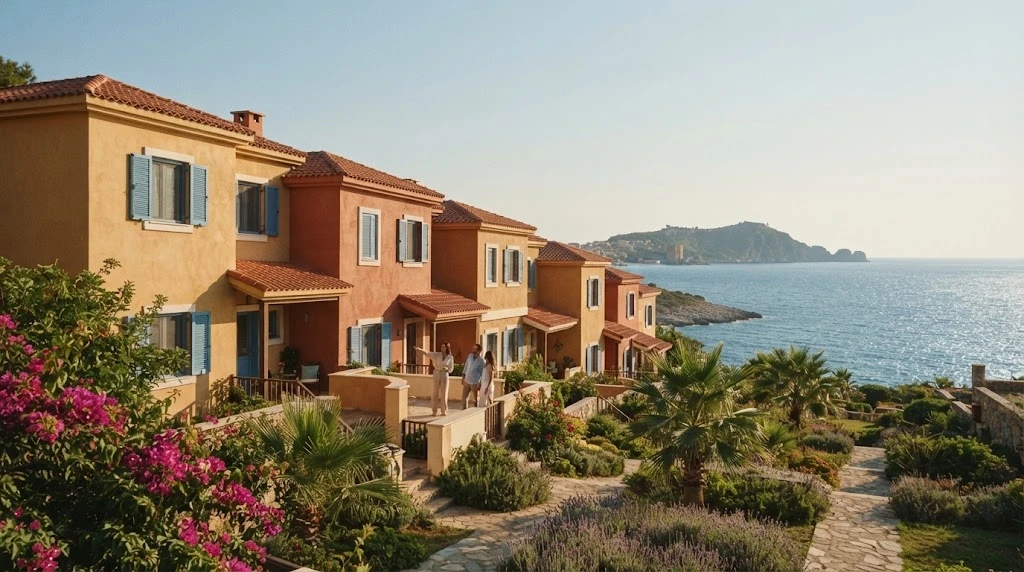
A seaside townhouse is often chosen by buyers who feel cramped in a flat, but find a detached villa too expensive or difficult to maintain. In Turkish property listings, this type of property is referred to by various names, and a single term may cover a range of different properties. The Ruyana team has been assisting buyers from Europe and the CIS for over 10 years, and below we break down this property type in the same way we do with our clients: by layout, documentation, budget and actual distance to the beach.
Townhouses in Turkey are units in low-rise buildings with a separate entrance and a shared wall with neighbours. By the sea, this type of property is suitable for family holidays and long-term living, provided you are happy with the staircases, the complex’s rules and the maintenance costs. You should compare prices based on specific offers, checking the documents, garden rights and the actual route to the beach.
What is a townhouse in Turkey?
A townhouse in Turkey is a unit in a low-rise building that has its own entrance from the street or the complex’s grounds and shares side walls with neighbouring units. There is usually no flat above a townhouse owner’s property: the living space occupies all the floors of their section. The number of storeys, and whether there is a garden, a swimming pool or a shared roof, depends on the specific design, and none of these features is a mandatory characteristic of this type of property.
When searching on the Turkish site, the buyer will come across several symbols. Terraced house It literally means «a house in a row» and is closest to the familiar concept of a terraced house. Semi-detached villa — a semi-detached villa, that is, a building comprising two sections sharing a common wall. Duplex — a duplex, a split-level layout. These terms serve as search criteria rather than interchangeable legal categories. In the property register, a property is described according to its legal status, not by the marketing name used in an advert.
A duplex in Turkey may be a standard flat in a block of flats, rather than a detached house. For example, a garden duplex on the ground and basement floors has an entrance from the terrace and a small plot of land, but there are neighbours living above it. Such a property is often included in «townhouse» listings, although in terms of lifestyle and regulations it is closer to a flat.
A common mistake we see buyers making is that they compare the prices of «townhouses» in different property listings without realising that the same category includes semi-detached houses, garden duplexes and even two-storey flats. Therefore, the first step is to check that the name given in the advert matches the actual floor plan, the building plans and the entry in the land registry.
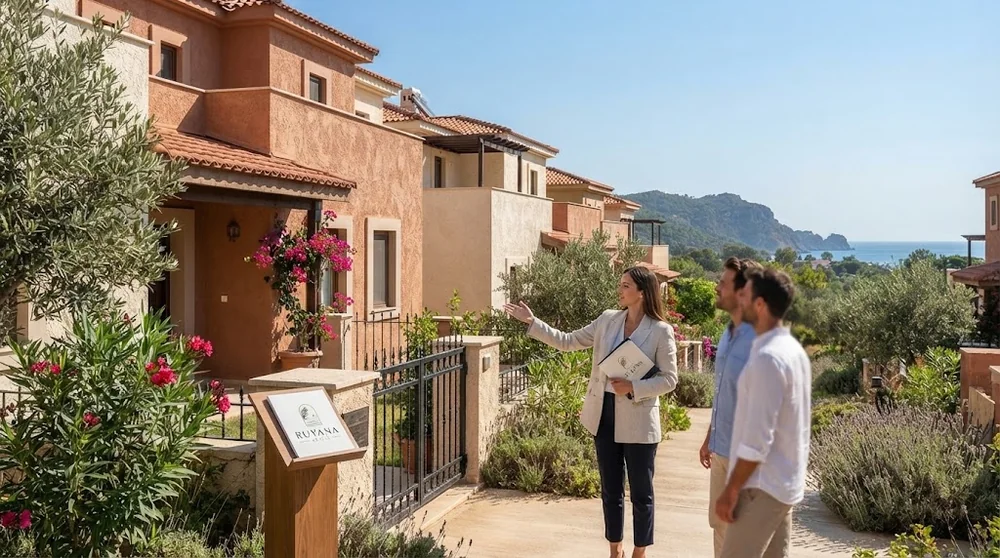
A townhouse, a villa or a flat: which to choose
It is best to choose between the different formats based on practical considerations: how many shared walls the property has, whether there are neighbours above, how the entrance is arranged, and who manages the outdoor area. The table below shows the typical differences. Specific specifications always depend on the project, so the table is intended as a guide for questions to the seller, rather than a description of any particular property.
| Format | Shared walls | The neighbours upstairs | Login | Outdoor area | Stairs | Controls and restrictions |
|---|---|---|---|---|---|---|
| Townhouse (sıra ev) | Usually one or two side walls | Usually not | Separate | A garden or terrace may be available; this is subject to verification of the relevant documents | Often, an internal staircase between levels | The complex has management rules and aidat in place |
| Semi-detached villa (ikiz villa) | A shared wall | Usually not | Separate | It often covers a larger area than a section in a row | Usually there is | It depends on whether the building is part of the complex |
| Detached villa | No | No | Separate | A site or area where the security arrangements need to be checked | It depends on the project | The owner bears more of the maintenance costs themselves |
| Garden duplex | Often several | Usually, yes | Separate entrance from the terrace or shared entrance from the building’s main entrance hall | A garden may be jointly owned property with designated use | An internal staircase between the levels | Rules for a block of flats |
| A standard flat | A few | Usually, yes | From the entrance hall or corridor | As a rule, only the general area | It depends on the floor and the lift | Rules for a block of flats |
A penthouse is a flat on the top floors, often spread over two levels and featuring a large terrace; it is therefore classified as a flat rather than a townhouse.
In the Ruyana team’s experience, townhouses are chosen by those who value not having neighbours above them and having their own entrance, but who are prepared to deal with stairs and the complex’s rules. A detached villa offers more privacy but also more responsibilities. Flat living is generally easier in terms of stairs and upkeep, but offers less privacy.
If there is someone in the family with limited mobility, stairs may be a decisive factor against choosing a multi-storey townhouse. In that case, we recommend first checking whether there is a bedroom and a bathroom on the ground floor, and only then comparing prices.
Where to look for a townhouse by the sea in Alanya
Alania stretches along the coast, and living conditions vary considerably from one neighbourhood to another. We do not rank neighbourhoods by price or «best» location: such a ranking, without a verified sample, is misleading. Below are the areas where it makes sense to look at what’s on offer, and the questions you should ask about each one.
- Konakly — an area to the west of Alanya city centre. When searching, it is worth checking the distance to the city centre, whether shops and services are open during the winter months, and how a particular complex is situated in relation to the D400 motorway.
- Avsallar — an area further west. Here, it is worth comparing properties based on the terrain: some of the developments are situated on slopes, and the route to the sea may involve a significant climb on the way back.
- Kargydzhak — an area to the east of the city centre. When making a selection, they check the property’s elevation above sea level, the availability of pavements along the route, and transport links to the city during the relevant season.
- Other areas of Alanya should be considered using the same criteria if an object of a suitable format appears in them.
Sea view, beachfront and walking distance to the beach
A sea view, proximity to the sea and easy walking access to the beach are three different characteristics, and none of them implies the others. A property on a hillside may offer panoramic views whilst actually being situated some distance from the shore along the actual route. The term «front-line» is used inconsistently in property adverts, so it is best to check this on site.
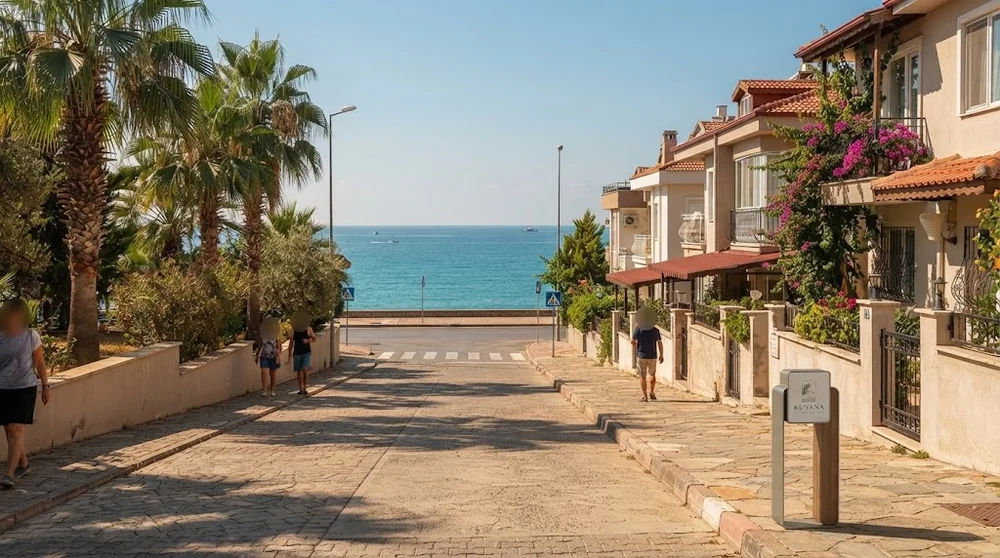
The process is as follows: you exit the gate of a specific section and walk to the water, timing your journey. Along the way, take note of the gradient, the presence of a pavement, lighting in the evening and the condition of the surface. If the route crosses the D400 road, check whether there is a safe crossing nearby – an underpass, overpass or controlled crossing. Once at the water’s edge, check whether the path to a public beach follows a legal route, rather than cutting through private hotel grounds or a building site. The return journey in the heat, especially if it involves an uphill climb, often proves to be the main inconvenience, which isn’t visible on the map.
Alternative cities for a brief comparison
If Alanya isn’t suitable, buyers usually compare other towns. We describe general living conditions and do not guarantee that suitable townhouses will be available in every town at the time of your search.
Antalya is a large city with a well-developed healthcare system and an airport, but distances within the city are greater, and a car is often needed for getting around. Belek is geared towards resort facilities and golf, and life there is more dependent on the season. Mersin is a large city with a more relaxed tourist atmosphere. Bodrum and Fethiye are situated on the Aegean and western Mediterranean coasts, respectively, with more pronounced seasonal variations in services and a terrain that affects walking routes. Istanbul is a metropolis with a different climate and a different pricing structure, so data from Istanbul cannot be applied to resort areas.
How much do townhouses cost in Turkey?
There is no standard price list for seaside townhouses, and we deliberately do not publish average figures. Prices in property catalogues change every week, and listings often mix terraced houses with garden flats. The average price from such a listing gives a misleading indication. It is more useful to compile your own small sample focusing on a single neighbourhood and a single property type for a specific date.
The process works as follows. For each property listing, you note down the source and the listing number, the area, the price and currency, the date viewed, the net and gross floor areas (stating where these figures are taken from), the condition and year of construction, the confirmed property type (block of flats, semi-detached villa or garden duplex) and the walking time to the beach. Exclude properties of a different type from the comparison; do not average them together with townhouses.
There are two caveats regarding any figures taken from property listings. Firstly, the price quoted in an advert is the asking price, not the actual sale price. Secondly, official statistics do not publish a separate price index specifically for townhouses, and general housing data cannot be applied to this property type.
The table below shows what needs to be established for each sentence in order for the comparison to be accurate.
| Factor | What to check | Why does this affect the comparison? |
|---|---|---|
| Confirmed format | A flat, a semi-detached villa or a garden duplex in a block of flats | A split-level flat may be incorrectly classified as a townhouse, thereby distorting the minimum price |
| Net and gross area | Please specify exactly what is stated: the net floor area, the gross floor area of the section itself including walls, or the total advertising area including shares of communal areas; please ask for a breakdown of the area as per the project plans | Retailers use the term ‘brüt’ to refer to different measurements; a price per metre without a breakdown of the area’s composition is not comparable |
| Condition and year of construction | New-build, secondary market, need for renovation | On the secondary market, refurbishment costs and technical risks are added to the price |
| Garden and terrace | A separate area, common property or designated use | The seller may include a garden in the price, over which the buyer will have no title |
| The way to the beach | Walking time, gradient, crossings, authorised access to the shore | The distance as the crow flies on the map does not reflect actual accessibility |
| The complex and aidat | Scope of services, monthly fee, outstanding balance | High running costs affect the true cost of ownership |
| Currency and date | In which currency is the price quoted, and as at what date? | Fluctuations in the lira’s exchange rate against the euro and the dollar alter the comparison between advertisements from different months |
We recommend that clients check in advance which properties are actually comparable. It only makes sense to calculate a median or range for a group of properties of the same type, in the same area and in a similar condition. With a small sample size, it is more useful to look at individual examples rather than an average figure.
Full budget for purchase and maintenance
The cost of the project is just the first item on the budget. Expenditure is divided into mandatory payments, as set out in the regulations, and contractual costs, which depend on the agreement between the parties and the specialists selected. The provision in the law specifying who is liable to pay the fee does not prevent the parties from agreeing on a different practical allocation of costs; therefore, this allocation must be expressly set out in the contract.
According to the explanations The Turkish Tax Administration (GİB), as at October 2026 The transfer of ownership fee (tapu harcı) amounts to 2% for the buyer and 2% for the seller, payable separately. The levy is calculated on the basis of the declared actual transaction price, which must not be lower than the applicable tax value of the property. The levy is charged and paid in Turkish lira.
| Expenditure item | Type | How is it determined? | Amount in the budget |
|---|---|---|---|
| Price of the property | Negotiable | Contract of Sale | C (as per the contract) |
| Land registry fee, payable by the buyer | Mandatory under the regulations | 2% as at October 2026, with an actual transaction price not lower than the tax value | Calculation in lira as at the transaction date |
| Enrolment and other fees at TAPU | Compulsory | At the rates in force on the date of the transaction | Variable |
| Valuation | In accordance with the applicable requirements | A report from a licensed valuer, if required for the transaction | Variable, as per the estimate |
| Lawyer and translator | Contractual | Agreement with specialists | Variable, as per the estimate |
| The agency’s commission | Negotiable | Agency agreement | Variable |
| VAT (KDV) | May apply to a specific transaction | This depends on the seller, the property and the terms and conditions; please check with a tax adviser | Variable; do not count twice if already included in the price |
| Insurance (including compulsory earthquake insurance (DASK)) | Compulsory and voluntary | Property-specific policy | Variable, annually |
| Furnishing and fitting out | Voluntary | Your choice | B (as per the estimate) |
| Utilities: electricity, water, gas (where available), internet | Required upon check-in | Suppliers’ rates | Variable, one-off |
| Aidat | Compulsory as part of the package | The complex’s budget and the owners’ decisions | Included in C (monthly) |
| Utility services | Compulsory | Actual consumption | Included in C (monthly) |
| Property tax | Compulsory | Municipal rate as at the date of calculation | Variable, annually |
| Provision for repairs | Recommended | Technical inspection and the age of the building | R (as assessed by a specialist) |
The budget formula for the first year is as follows: First-year budget = C + O + B + 12 × S + P, where P is the price of the property, O is the administrative costs (fees, registration charges, valuation, solicitor’s fees, translator’s fees, commission and any VAT, if not included in P), B – fitting-out and one-off connection charges, C – average monthly maintenance costs (aidat, utilities, as well as annual insurance and tax, divided by 12), R – repair reserve. To avoid double-counting, allocate each item to only one group.
Below is a fully worked-out hypothetical example in lira. This is a sample calculation; it is not a market quote nor an official charge. The 2% levy rate is taken as at October 2026; all other amounts are hypothetical assumptions, which will differ in your transaction. For simplicity, the levy base is taken as equal to the transaction price, and VAT is assumed to be included in the price.
| Group | Article | Basis | Amount, TRY |
|---|---|---|---|
| Ц | Price of the property | Contractual price | 10 000 000 |
| Oh, the regulations | Land registry fee, payable by the buyer | 2% from 10,000,000 (rate as at October 2026) | 200 000 |
| Oh, the regulations | Enrolment fees at TAPU | A hypothetical assumption | 5 000 |
| Oh, the contractual ones | Valuation | A hypothetical assumption | 15 000 |
| Oh, the contractual ones | Lawyer and translator | A hypothetical assumption | 60 000 |
| Oh, the contractual ones | The agency’s commission | Approximately 2% of the price | 200 000 |
| Б | Furnishing and fitting out | Provisional estimate | 400 000 |
| Б | Connections (one-off) | A hypothetical assumption | 20 000 |
| 12 × C | Rent 4,000 + utilities 3,000 + insurance 1,000 + tax 1,000 per month | 9 000 × 12 | 108 000 |
| Р | Provision for repairs | An engineer’s provisional assessment | 150 000 |
| Total budget for the first year | 11 158 000 | ||
In this example, the registration fee (O) amounted to 480,000 lire, i.e. 4.8% of the price, whilst all costs in excess of the price totalled 1,158,000 lire. Insurance and tax are included only in C, whilst connection charges are included only in B, so there is no double counting. Property tax is usually charged to the new owner from the year following the purchase; in this example, it has been included as a guide for the annual budget.
Take currency risk into account separately. The commission and many running costs are paid in lira, whilst buyers often compare prices in euros or dollars. Use the official exchange rate for conversions The Central Bank of Turkey (TCMB) on the payment date. Exchange rate fluctuations between the time the deposit is paid and the transaction take place will affect the final amount in your currency, so it is wise to keep part of your budget in reserve.
Who is a townhouse suitable for, and what restrictions apply?
A townhouse works well in some scenarios but not in others. Below are some typical buyer scenarios and what to look out for in each one.
For families with children, a terraced house is often convenient because it has a separate entrance, no neighbours above, and access to a terrace or garden. For a seasonal buyer, it is important to understand who will look after the property whilst they are away and how much it costs to maintain an unoccupied property. A remote worker needs a stable internet connection and a quiet room. A buyer with limited mobility needs a fully accessible living area without stairs.
- A bedroom and a bathroom on the ground floor. If these are not available, a person with reduced mobility will have to rely on the stairs every day.
- Stair safety. Check the height of the steps, the handrails on both sides, the lighting and whether it is possible to fit a safety gate for small children.
- Acoustics of a shared wall. Ask to view the property at a time when the neighbours are at home, and listen for any noises coming through the wall.
- Privacy of the garden and terrace. Check whether the area is visible to neighbours and from the shared path.
- Car park. Please check whether the space is allocated to a specific section or whether it is a communal car park.
- The Internet. Find out which providers offer broadband at your address and what your neighbours’ actual speeds are.
- Winter services. Check whether the shops, transport and facilities within the complex are open in winter, and find out how the building is heated.
Damp, roofing, terraces and coastal technical risks
Near the sea, humidity and salt accelerate the deterioration of the building. During your inspection, look out for signs of mould in corners and on lower floors, particularly in basement areas. Check where water drains from terraces and the roof: the drainage system and slope should direct rainwater away from the walls. Metal railings, fixings and external air-conditioning units are prone to corrosion. In enclosed spaces without proper ventilation, moisture builds up over the winter whilst the property stands empty. In summer, in a multi-storey block, the top floor heats up more, and cooling costs may turn out to be higher than expected.
The fact that a building is low-rise does not in itself guarantee its seismic safety. A specialist engineer assesses the structural and seismic integrity of a particular building on the basis of the project documentation and the actual condition of the structure. In the secondary market, such an inspection is particularly useful if previous owners have altered terraces or combined rooms.
TAPU, the garden and the complex’s rules
A TAPU is a title deed issued by Directorate-General for the Land Cadastre and Registry (TKGM). A buyer of a townhouse in a development usually acquires a separate unit as a registered property and the associated share in the land plot. The fact that a plot of land is registered does not in itself mean that the specific area in front of the entrance belongs to the owner of that section.
The legal regime governing buildings comprising several independent sections is regulated by Law No. 634: The Condominium Law; the current version is published on the official legislation portal. There are two main statuses listed in the register. Condominium ownership — full ownership of a section, which is usually formalised once construction has been completed and the iskan has been obtained. Kat Alliance — the right to a future flat, which is characteristic of buildings under construction or not yet commissioned. ‘Kat irtifakı’ does not automatically preclude a transaction, whilst ‘kat mülkiyeti’ does not automatically guarantee that there will be no problems. Each status requires its own verification.
An ‘iskan’, or ‘yapı kullanma izin belgesi’, is a building occupancy permit issued by the local authority upon completion of construction. A solicitor compares the iskan with the approved plans and the actual layout of the property. A common mistake we see among buyers is that a flat has been extended to include a glazed terrace or an annexe that is not included in the approved plans. Such alterations can cause complications during registration and any subsequent sale.
The garden requires special attention. The area in front of the block may fall into one of three categories:
- separate property or part of an independent section, if this is expressly stated in the documents;
- the common property of all the owners of the complex;
- common property with a right of use reserved for the owner of a specific section.
The fence around the garden and the seller’s statements do not confirm the legal status of the land. The status is determined by the register, the approved project and the complex’s regulations.
The complex’s rules are set out in the yönetim planı — the management plan — which is binding on owners. The yönetim planı and the decisions of the general meeting are used to determine who may use the car park and swimming pool, who is responsible for the roof and façade, whether it is permitted to alter a terrace, erect a canopy or install a fence, how maintenance costs are allocated, and how special levies for major repairs are introduced. The monthly contribution, known as the ‘aidat’, is calculated based on the complex’s budget.
We recommend that clients check the following three documents from the management company or property manager in advance: the current budget for the development, a certificate confirming that there are no outstanding aidat payments for the unit being sold, and the minutes of the most recent general meetings. These minutes often reveal future expenditure, such as planned repairs to the roof or swimming pool.
Purchases by foreign nationals, residence permits and holiday rentals
Buyers often confuse three different issues: whether a foreign national can purchase a property, whether the purchase entitles them to a residence permit, and whether the property can be let to tourists. Each of these matters is decided by a separate body in accordance with its own rules, and a positive decision on one does not imply a positive decision on the others.
Can a specific foreign national buy a townhouse?
Eligibility to purchase depends on the buyer’s nationality and the property’s characteristics. The rules for citizens of the EU, the UK, CIS countries and other states are assessed on a case-by-case basis. The purchase may be subject to territorial restrictions, such as the property being situated in a special-status zone, and restrictions on floor area. This check is carried out via the TKGM as part of the transaction preparation. In the Ruyana team’s experience, it is advisable to carry out this check before paying the deposit, rather than before signing the deed at the Land Registry.
Financial grounds for a residence permit
A residence permit (ikamet) is issued by The Turkish Migration Directorate (Göç İdaresi). According to our practice as at October 2026, for the property-based route, the threshold for the value of the property is at least the equivalent of US$200,000 in Turkish lira as at the date of purchase. This threshold must be checked against the current requirements of the Göç İdaresi as at the date of application: Whether the condition applies depends on the date of purchase, the property’s address and the applicant’s circumstances, including restrictions relating to registration districts. Ownership of a townhouse does not guarantee approval of a residence permit: the decision is made by the immigration authority after reviewing all the documents. We recommend checking the requirements separately from the transaction.
Holiday lettings under Act No. 7464
Act No. 7464 introduced a licensing regime for the letting of accommodation for tourism purposes. As of October 2026, a ‘turizm amaçlı kiralama izin belgesi’ — a tourist rental permit issued by the Ministry of Culture and Tourism — is required for letting accommodation under contracts for a period of up to and including 100 days. The status is determined by the duration of a single tenancy agreement, rather than by an annual limit or by how the parties describe the purpose of the tenancy.
For a section within a building with multiple owners, the general requirement is the unanimous consent of all owners of the building in question. Exceptions depend on the specific layout of the development and must be verified against the relevant documents. The term «townhouse» and a separate entrance do not, in themselves, constitute exceptions nor do they confirm the right to let a section to tourists.
Would you like to find out whether it’s possible to obtain a licence for holiday lettings in a specific development? Please message us on WhatsApp using the contact details on the website buy-property-turkey.com — A lawyer from the Ruyana team will check the status of the building before the property is selected.
We do not guarantee a rental yield. An actual calculation is only made after the permitted use has been verified. The following are deducted from gross revenue: downtime between guests, commissions payable to the platform and the management company, cleaning, utility bills, aidat, taxes and wear and tear on furniture. The team’s view: regarding rental matters, it is best to seek a lawyer’s advice on the specific building before selecting a property, as it is the building’s legal status that determines whether holiday rentals are permitted.
What to check before paying a deposit on a townhouse
Before paying a deposit, please ensure that you have completed each step of the verification process and that there is a supporting document and a designated specialist for each step. The sequence below reflects the process our team follows when handling transactions.
- Define the objective and the budget. Outline your scenario: a holiday home, permanent residence, a residence permit or a rental property. Draw up a budget for the first year using the formula from the section on expenses.
- Please confirm the format and the object’s identifiers. Obtain the section number and the plot details (cadastral number and parcel number) and compare them with the site plan. Your solicitor will be the one to check this.
- Check the seller and their credentials. If the seller is acting under a power of attorney, a solicitor checks the scope and duration of the power of attorney. In the case of a property developer, they check whether the developer has the right to sell a specific section.
- Check the register and restrictions. The solicitor requests an extract from the TKGM register and checks for mortgages, seizures, restrictions on disposal and the status of kat mülkiyeti or kat irtifakı.
- Compare the design, iskan and the actual structure. A lawyer and an engineer will compare the approved plans and the building occupancy permit with what you can see on site, including terraces and extensions.
- Please confirm the status of the garden and the management arrangements. Request the management plan, the estate’s budget, a statement of outstanding maintenance charges and the minutes of meetings.
- Carry out a technical inspection and follow the route to the beach. An independent engineer assesses the damp, the roof, the drainage and the building structures. Walk the route yourself from the gate to the water supply and back.
- Check your residence permit or tenancy agreement, if these are relevant to the purpose of the purchase. An immigration specialist checks the requirements set by the Göç İdaresi, whilst a lawyer assesses the feasibility of obtaining a tourist rental permit.
- Please confirm the contract, the refund and the payee. The deposit agreement sets out the amount, the recipient, the timeframe, the conditions for a refund and the allocation of administrative costs. The payment is made only to a verified recipient.
- Please carry out the necessary checks before applying for a TAPU. Before the transaction, the solicitor checks the register again, as restrictions may arise after the deposit has been paid.
Discrepancies in the section number, unclear powers of the seller, unconfirmed status of the housing development, discrepancies between the plans and the actual property, or unclear terms regarding the refund of the deposit — these are sufficient grounds to put the transaction on hold. Taking a few days’ break works out cheaper than a dispute after payment.
Hypothetical scenario 1. A family with two children is looking for a house for the summer months. Their priorities are a safe staircase, an enclosed garden with a clear status, a footpath to the beach without having to cross a main road, and a reasonable aidat. If the garden turns out to be communal property with no designated use, the family will reconsider their choice.
Not sure which is best for you – a townhouse, a garden duplex or a flat? Take a short quiz on the website buy-property-turkey.com: We’ll suggest a comparison based on household composition, time of year and budget.
Hypothetical scenario 2. A buyer with limited mobility plans to live by the sea all year round. For them, the decisive factors will be a bedroom and bathroom on the ground floor, a level route without steep gradients, and the availability of services during the winter. In this scenario, a multi-level property without a living room on the ground floor is generally unsuitable, and a garden duplex or a flat with a lift may prove more convenient.
Frequently asked questions about townhouses in Turkey
How does a townhouse in Turkey differ from a villa and a duplex?
A townhouse is usually a section of a house with a separate entrance and a shared side wall with the neighbouring section. A detached villa stands on its own, whilst a duplex refers to a two-storey layout and may simply be a flat with neighbours above. In Turkish property listings, the terms are often used interchangeably, so the property type should be verified by checking the plans, conducting a viewing and reviewing the extract from the land registry, whilst land and garden rights should be clarified separately with a solicitor.
How much does a townhouse by the sea in Turkey cost?
It is not possible to quote a single price for seaside townhouses: the cost depends on the town, neighbourhood, floor area, condition, rights to the outdoor area and access to the beach. A rough guide can be obtained from current, comparable listings of the same type on a specific date, with a breakdown of net and gross floor area. Listing prices do not necessarily reflect actual transaction prices, and the lowest price in the catalogue may refer to a garden flat. Add the registration fees to the price: in our example, these amounted to approximately 4.8%.
Where can I look for a townhouse by the sea in Alanya?
To start with, you could check out the properties in Konaklı, Avsallar and Kargıcak, making sure you clarify the actual layout of each property. You should choose based on the specific address: a sea view does not necessarily mean easy access to the beach. Walk the route from the gate to the water and back, check the gradient, crossings over the D400, pavements, and the availability of shops, transport and services during the season you’ll be staying.
Will the plot in front of the townhouse be my property?
Not necessarily. The garden in front of the block may be a separate plot according to the documents, common property of the estate, or an area designated for the owner’s use. A fence and the seller’s words do not confirm the legal status. Before paying the deposit, ask an independent solicitor to compare the TKGM extract, the approved plans and the yönetim planı, including any restrictions on fencing, canopies, extensions and the use of the garden.
Is it possible to obtain a residence permit when buying a townhouse?
Purchasing a townhouse does not in itself grant a residence permit. According to our experience as at October 2026, the property-based route requires the property to be valued at no less than the equivalent of 200,000 dollars in Turkish lira on the date of purchase. This threshold, the property’s address, restrictions on registration districts and other requirements must be checked against the current requirements of the Göç İdaresi at the time of application; the decision is made by the immigration authority.
Is it possible to let out a townhouse to tourists?
The possibility of letting the property to holidaymakers must be checked before purchase. As of October 2026, Law No. 7464 requires authorisation for tenancy agreements for periods of up to and including 100 days. For a unit in a building with multiple owners, the general requirement is the unanimous consent of the owners of that building, whilst exceptions depend on the layout of the development. The designation «townhouse» and a separate entrance do not, in themselves, confer the right to let the property.
Conclusion
The decision to buy a townhouse by the sea can be summarised in four key points. The layout suits all family members, including those who find it difficult to climb stairs. Ownership of the property, garden and parking space is confirmed by documentation. The walking distance from the gate to the beach is reasonable in hot weather and in both directions. The full budget for the first year takes into account registration costs, maintenance, a contingency fund for repairs and currency risk. If at least one of the four conditions is not met, the item should be set aside and the comparison resumed.
In the Ruyana team’s experience, the choice becomes easier when several properties are compared using the same criteria, rather than just the photographs and the name in the advert. If you’d like to make such a comparison, please let us know your budget, family composition, the season you’ll be staying in, and the maximum walking time to the sea — based on this information, we’ll match suitable options in terms of layout, documentation, the route to the beach and your overall budget.
This material is for general information purposes only and does not constitute legal, tax or financial advice. The documents and terms of a specific transaction are reviewed by relevant specialists: a solicitor, a licensed valuer, an engineer and a tax adviser. The information is current as of October 2026.
 Property in Georgia
 Property in Montenegro
 Property in Cyprus
 Property in the UAE
 Property in Bali
 Property in Thailand
 Property in Spain
 Property in Saudi Arabia
 Property in Zanzibar
 +90 531 719 64 01
 hello@buy-property-turkey.com
 Summer Park Business Centre, Block 8A, No. 3, 07400 Oba, Alanya/Antalya, Turkey

 Get the catalogue of the top 7 properties