
 +90 531 719 64 01


Penthouses in Turkey are chosen by buyers who want a large terrace, plenty of natural light and a sea view. This type of property is suitable for living, holidaying and, occasionally, letting, but it does have its own technical and legal considerations. My name is Elena, I work as part of the Ruyana team, and in this article I explain how to assess the price, the neighbourhood, the paperwork and the actual costs before paying a deposit.
Penthouses in Turkey are ideal for families, holiday home buyers and anyone looking for a spacious terrace, privacy and sea views. In Alanya, properties listed in October 2026 start at around €125,000–150,000, though the price depends on the area, size and condition of the building. It is worth looking in Oba, Kestel, Mahmutlar, Kargicak and the centre of Alanya. Before buying, check the TAPU, the status of the terrace, the roof and the maintenance costs.

What is a penthouse in Turkey?
A penthouse in Turkey is usually a flat on the top floor of a residential building, featuring a larger floor area, a private or dedicated terrace and unobstructed views. In Turkey, the word ‘penthouse’ is most commonly used in advertising. It is not a legal term and, in itself, does not confirm the floor area, rights to a terrace or the legality of the layout.
Advertisements using the term «penthouse» are used to sell a variety of properties. It could be a single-level flat on the top floor with a large open terrace. It could be a two-level flat, where the second level is situated under the roof. Sometimes, the term is used to refer to a standard top-floor flat with access to part of the roof. The legal status of each of these options is determined by the relevant documents, rather than the name used in the advert.
Penthouse, duplex and flat with a terrace: the differences
A penthouse is a two-storey flat on the top floor, where the second storey is situated under the roof or at roof level. In Alanya and Antalya, the majority of properties labelled ‘penthouse’ fall into this category. A terrace flat is a flat with a large terrace, which may be on any floor, including the top floor. A standard top-floor flat has the same layout as the flats below it and differs only in terms of which floor it is on.
| Format | Key characteristics | Advantages | Restrictions |
|---|---|---|---|
| A classic penthouse | A single-storey flat on the top floor, with a large terrace running around the perimeter or on one side | No internal staircase, panoramic views, privacy | Less common, more expensive, heat from the roof |
| Roof-top duplex | Two levels: the living floor and the attic level with a terrace | A large space, with a separate area for guests or a study | Internal staircase, sloping ceilings, the risk of unregistered premises |
| Terrace flat | A flat with a large terrace on any floor | An open-plan space without a mandatory upper floor | A terrace may be communal or reserved solely for the right of use |
| Top-floor flat | Standard floor plan on the top floor | No neighbours above; usually more affordable | There is no extra space, and the same risk of overheating and leaks remains |
A common mistake we see buyers making is this: someone sees «180 m² penthouse» on a website and assumes that the entire 180 m² belongs to them. In practice, this figure may include communal areas, an open-air terrace and spaces under the roof that are not registered as residential. Therefore, the property’s layout must be determined in accordance with the Land Use and Planning Certificate (TAPU) and the approved plans.
Who is each format suitable for?
A classic single-level penthouse is ideal for pensioners and people who find it difficult to climb stairs. A roof-top duplex is suitable for families with children, as it allows for separate bedrooms and a communal area, and for buyers who frequently entertain guests. A terrace flat is suitable for those who value an outdoor space but do not insist on being on the top floor. A standard top-floor flat is suitable for buyers who want the peace and quiet of being on the top floor without paying extra for additional space.
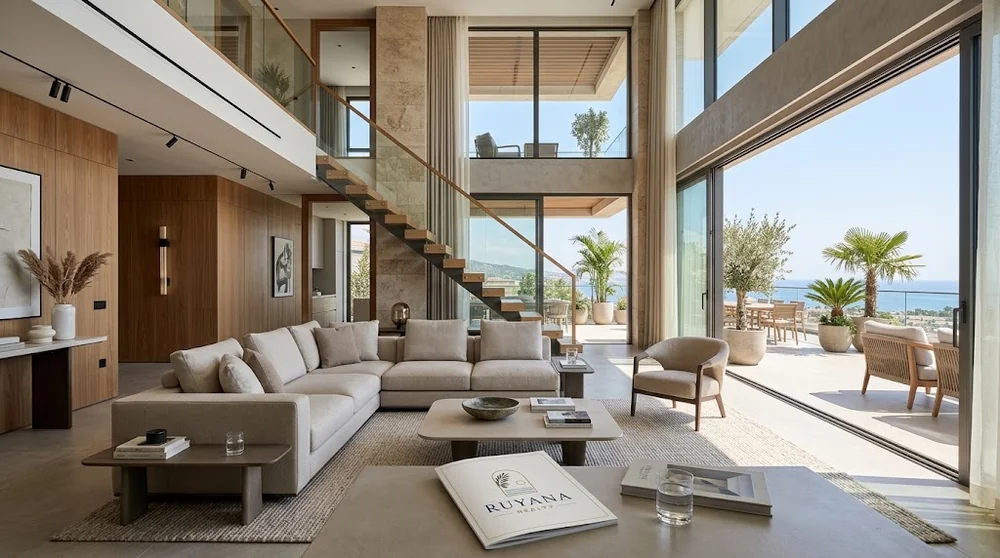
Who are penthouses in Turkey suitable for?
A penthouse in Turkey serves specific purposes: it provides extra space, an open-air area and greater privacy. However, this same layout can cause inconvenience if the buyer rarely visits, struggles with the heat or does not wish to maintain a large property. In the Ruyana team’s experience, it is best to base your decision on your lifestyle rather than on photographs showing the view.
For permanent residence and holidays
- Families with children: The split-level layout allows the bedrooms to be situated separately from the living room, whilst the terrace serves as a small garden. Care must be taken to ensure the safety of the staircase and the height of the terrace railings.
- A couple or pensioners: A single-level penthouse with a reliable lift offers comfort and privacy. For people with reduced mobility, the internal staircase in the çatı dubleksi poses a significant obstacle.
- Remote working: The top floor is ideal for use as a study. Before buying, it’s worth checking the internet speed in that particular house and how well the attic room is cooled in summer.
- A second holiday home: A terrace is particularly valuable in spring and autumn. If the owner is away for several months, they need someone to check the drainage, the windows and the equipment on the roof.
- Buyers moving to their permanent place of residence: For them, the area’s year-round infrastructure is more important than the view. Shops, clinics and schools must remain open in winter.
For letting and subsequent resale
A penthouse may appeal to tenants who require several bedrooms and a terrace, such as families or groups of friends. However, the target market for such tenants is narrower than that for 1+1 and 2+1 flats. High purchase and maintenance costs may reduce the net return. Resale liquidity depends on the quality of the building, the view, the legal status of the terrace and the presence of a lift. Buyers of large penthouses usually compare them to villas, so selling one may take longer than selling a standard flat.
A standard flat would be a more sensible choice than a penthouse in the following situations:
- The buyer or members of their family have difficulty using the stairs.
- The owner plans to visit no more than once or twice a year.
- The budget is limited, and the costs of maintaining such a large area will be significant.
- The main objective is to secure stable, long-term tenancies with a diverse range of tenants.
- The buyer does not cope well with the heat, and the house does not have good roof insulation.
- The property is required for the purpose of applying for a residence permit, but the price of the penthouse falls short of the specified threshold.
How much will penthouses cost in Turkey in 2026?
The prices for penthouses in Turkey quoted in this article are the asking prices in the property listings, not the amounts paid in completed transactions. Official statistics from TÜİK publish data on the number of property sales, including those to foreign buyers, but do not list penthouses as a separate category. Consequently, price indicators for this property type can only be obtained from samples of property listings, and each sample has its limitations.
Prices for penthouses in Alanya
As of October 2026, the median asking price for penthouses in Alanya on the BasicApartment website was around €169,000–172,000. The same sample also included listings ranging from approximately €125,000 to €150,000. Premium properties with large floor areas, views of the fortress or the sea, and those in new developments were listed at significantly higher prices, with some listings exceeding €500,000. These figures reflect only properties listed on a single platform during a specific period and do not represent the average market price.
The lower end of the price range often applies to properties on the secondary market, houses without a swimming pool, flats situated some distance from the sea, or properties with a terrace of questionable quality. We advise clients to check in advance why a property is priced below the median. Sometimes the reason is straightforward, such as a rushed sale. Sometimes it relates to documentation or the technical condition of the roof.
Why do similar penthouses vary in price?
Two penthouses of the same size advertised may differ in price by a factor of two. The following factors influence the price:
- Area and distance to the beach: A walking route that does not cross the D400 is considered preferable.
- Actual appearance: An unobstructed sea view is more expensive than a side view or a view of the mountains.
- Legal area: The registered area is more important than the advertising area.
- Terrace status: A terrace that forms part of a flat, or is considered an ‘eklenti’, is valued higher than the right to use a shared roof.
- Year of construction and condition of the house: New housing estates with swimming pools and security are more expensive than older houses without amenities.
- Renovations and furniture: A property that is ready to move into is more expensive, but the furniture is sometimes valued higher than its actual worth.
- Availability of iskan: A property without a certificate of occupancy carries an additional risk and is usually cheaper.
We do not have a comparable and verified sample of penthouses for October 2026 for other resorts in Turkey. Therefore, the table below lists the cost factors for these cities without any hypothetical price ranges.
| City | Typical proposal format | Price guide | Key cost factors | Date and type of source |
|---|---|---|---|---|
| Alanya | Penthouse flats in complexes with a swimming pool | The median price is around €169–172 thousand, with properties listed from €125–150 thousand. | Area, view, distance to the sea, terrace status | October 2026, a selection of listings from BasicApartment |
| Antalya (Konyaaltı, Lara) | Top-floor flats and duplexes in city-centre developments | Requires verification against current proposals | Proximity to the beach, neighbourhood, local amenities | There is no verified sample for October 2026 |
| Mersin | Duplex flats in high-rise complexes by the sea | Requires verification against current proposals | District (Mezitli, Teje, Erdemli), floor, view | There is no verified sample for October 2026 |
| Bodrum, Fethiye, Belek | Penthouses in low-rise developments, often situated next to villas | Requires verification against current proposals | Seasonal demand, views of the bay, height restrictions | There is no verified sample for October 2026 |
| Istanbul | Penthouses in city residences | Requires verification against current proposals | Neighbourhood, view of the Bosphorus, transport | There is no verified sample for October 2026 |
How to read prices in euros, dollars and lira
Sellers in Alanya often quote prices in euros, whilst developers in Istanbul and Mersin quote prices in dollars; however, the amount is shown in Turkish lira on the TAPU and in payment documents. We use the official exchange rate for conversion Central Bank of the Republic of Turkey (TCMB) as at a specific date. In this article, we do not provide a conversion into lira, as the exchange rate changes daily and an out-of-date calculation would mislead the reader.
A price quoted in euros does not protect the buyer from currency risk if their income is in a different currency. A buyer from the UK pays in pounds, whilst a buyer from the CIS often holds their savings in dollars. The difference between the exchange rates on the date of the deposit and the date of the TAPU may affect the final amount. We recommend specifying the payment currency and the conversion method in the contract.
Where to buy a penthouse by the sea in Alanya
Alanya is a long resort town that stretches along the coast for several tens of kilometres. The different neighbourhoods vary in terms of building density, seasonality, transport links and how close the properties are to the sea. Below, I compare the main districts according to criteria that are important to a penthouse buyer. No single neighbourhood is the best for everyone: the choice depends on the purpose of the purchase and your budget.
As a guide to prices, we are using the median asking prices for penthouses listed on the BasicApartment website as at October 2026: around €162,500 in Mahmutlar, €177,000 in Oba, €180,000 in the centre of Alanya and €199,000 in Kargicak. The number of properties in each sample is limited; therefore, these figures do not represent all properties in the area and do not reflect actual transaction prices.
Oba and Kestel: accommodation and facilities
Both are residential areas to the east of the centre of Alanya, with facilities available all year round. There are supermarkets, markets, private clinics, schools and cafés here, which remain open throughout the winter. Most of Oba is situated above the D400 road, so the route to the beach often involves crossing the road. The area has many residential complexes with swimming pools, built in recent years. Penthouses here usually offer mountain views or partial sea views. Oba is suitable for families and buyers planning to live in Alanya permanently.
Kestel is situated to the east of Oba and Tosmur. The area is quieter, with less dense development, and some of the houses are situated closer to the sea. The amenities are more basic than in Oba, but it is a short drive away. Tosmur lies between Oba and Kestel, next to the Dimchay River, and is ideal for buyers looking for a quiet residential environment. In Kestel and Tosmur, it is particularly important to check the actual view from the terrace carefully, as new houses may block the panorama.
Mahmutlar and Avsallar: a wide range of options
Mahmutlar is an eastern district of Alanya with a large number of residential complexes and foreign residents. There is a wide selection of penthouses here, built in different years and across various price ranges. The district’s main street is lined with shops, restaurants and services that are open all year round. Gazipaşa-Alanya Airport is closer to this area than it is to the city centre. Mahmutlar is ideal for buyers who value choice and a community of expats. It is worth bearing in mind the dense development: the view from the terrace of one property may differ significantly from that of a neighbouring one.
Avsallar is situated to the west, closer to Antalya Airport. The area is known for İncekum Beach and is more seasonally dependent: some cafés and shops are only open in the summer. Prices here are often lower than in the central districts, but before buying, you should bear in mind the distance from the city’s amenities. Avsallar is suitable for holidaying during the season and for buyers who are prepared to travel to the city for shopping and medical appointments.
Kargijak and the centre of Alanya: views, privacy and access to amenities
Kargydzhak is a hilly area to the east of Mahmutlar, where penthouses often offer panoramic sea views. The houses are situated on the hillsides; the development is less dense and there is greater privacy. In return, buyers find themselves reliant on a car: it is usually a long walk to the beach and shops, and the slopes are steep. Kargydzhak is ideal for buyers whose main priorities are the view and peace and quiet.
The centre of Alanya offers the most convenient urban environment: Cleopatra Beach, the seafront promenade, the fortress, hospitals, government offices and transport links. There are fewer new complexes with swimming pools here; many of the buildings are older, and parking is limited. A penthouse in the centre is often the top-floor flat in a building without much surrounding land. For such properties, a technical inspection of the roof is particularly important.
| District | Who is it suitable for? | Advantages | Restrictions | Median asking price, October 2026 |
|---|---|---|---|---|
| Both | Families, permanent residence | Year-round services, schools, clinics | Crossing the D400; not all houses have a sea view | Around €177,000 (BasicApartment) |
| Kestel and Tosmur | For couples, for those seeking peace and quiet | A peaceful setting, close to Oba | Fewer local amenities; the risk of new development in front of the house | There is no specific verified value |
| Mahmutlar | For shoppers looking for choice | Many residential complexes, a community of expats, and proximity to Gazipaşa Airport | Dense development, with neighbouring houses offering different views | Around €162,500 (BasicApartment) |
| Kargydzhak | For those who value appearance and privacy | Panoramas, low density | I need a car; there are some steep hills | Around €199,000 (BasicApartment) |
| The centre of Alanya | For those who want to live in the city | Cleopatra Beach, hospitals, transport | Old housing stock, few car parks | Around €180,000 (BasicApartment) |
| Avsallar | For a holiday during the season | İnjekum Beach, closer to Antalya Airport | Pronounced seasonality, distance from the centre | There is no specific verified value |

Alanya or other resorts in Turkey
The same budget offers different options in different cities across Turkey. This is due to differences in demand patterns, land prices and planning restrictions. A penthouse buyer should compare cities in terms of the comfort of permanent living, proximity to an airport and seasonality, rather than the resort’s general reputation.
Antalya and Mersin
Konyaaltı is a district in the west of Antalya with a pebble beach and well-developed urban infrastructure. Lara is situated to the east, closer to Antalya International Airport, and has sandy beaches. As a major city, Antalya offers a year-round lifestyle, universities and hospitals, but the density of development is higher than in most areas of Alanya. Mersin is a city on the eastern Mediterranean coast with high-rise complexes by the sea in Mezitli, Tezgâh and Erdemli. Mersin is less geared towards mass tourism, so demand for short-term rentals is lower there, and life is more urban.
Bodrum, Fethiye, Belek and Istanbul
Bodrum and Fethiye are situated on the Aegean and western Mediterranean coasts. There are many low-rise buildings and villas here, and the seasonality is more pronounced than in Alanya. Belek is a resort area with golf courses and hotels near Antalya Airport, where residential infrastructure is less developed out of season. Istanbul is an urban alternative with a different set of priorities: buyers are interested in the neighbourhood, transport and work, rather than the beach. Penthouses in Istanbul are usually located in high-rise residential buildings, and prices vary considerably from one neighbourhood to another.
| Location | Nearest airport | Seasonality | Life all year round |
|---|---|---|---|
| Alanya | Gazipaşa-Alanya, Antalya | Average; depends on the area | Yes, especially in Oba, Mahmutlar and the city centre |
| Antalya (Konyaaltı, Lara) | Antalya | Low for the city | Yes |
| Mersin | Chukurova | Low | Yes |
| Bodrum | Milas–Bodrum | High | To a limited extent outside the central districts |
| Fethiye | Dalaman | Medium and high | Yes, in the city centre, and to a limited extent in resort areas |
| Belek | Antalya | High | Limited |
| Istanbul | Istanbul, Sabiha Gökçen | No seasonal fluctuations typical of holiday resorts | Yes |
The pros and cons of a top-floor penthouse
Being on the top floor offers a penthouse both its greatest advantages and its greatest risks. The roof shields the flat from noise made by neighbours above, but it is exposed to the sun, rain, wind and salt in the sea air. Any decision to buy must take both aspects into account.
The benefits of living by the sea
The penthouse has no neighbours above, so there is no risk of noise from footsteps or leaks from the flat above. The flat enjoys more natural light and often offers unobstructed views of the sea or the mountains. The terrace allows you to have breakfast outdoors and to place outdoor furniture and plants there. The generous floor space makes it possible to set aside a study or a guest area. In the Ruyana team’s experience, buyers who live in Alanya from October to May particularly appreciate the terrace: during this time of year, it is a comfortable place to spend most of the day.
These advantages come at a price. In summer, the roof and terrace get very hot, and air-conditioning costs in a penthouse are usually higher than in a flat on a middle floor. In winter, an apartment with poor insulation loses heat more quickly. The wind is stronger on the top floor, so furniture and awnings need to be securely fastened. The sea air accelerates corrosion of metal railings, window frames and external air-conditioning units. Noise may be caused by equipment on the roof: pumps, water heaters and neighbours’ air-conditioning units. If the lift is out of order, top-floor residents have to walk up the stairs, and in a roof-top duplex there is an additional internal staircase.
Seven technical checks to carry out before buying
- Roofing: Check the roof covering, the joints, the connections to the walls and parapets, the condition of the solar water heaters and the equipment fixings.
- Waterproofing a terrace: Find out when it was last renovated, who carried out the work and whether there is a guarantee; check for cracks in the tiles and grout.
- Draining the water: Check the gradients, the number and cleanliness of the drainpipes, and ensure there are overflow points in case of blockages.
- Signs of damp: Check the ceilings, corners, window reveals and the walls beneath the terrace for stains, blistering paint and mould; if possible, view the flat after it has rained.
- Ventilation and cooling: Assess the roof’s thermal insulation, the number and age of the air-conditioning units, and the temperature on the top floor on a hot day.
- Lift: Find out whether the lift goes to the top floor, whether it has a backup power supply, and whether there is a valid maintenance contract.
- Windows and fittings: Check that the sliding doors leading onto the terrace are airtight, and check the profiles for corrosion and the condition of the seals.
An independent technical survey is required if there are visible signs of water damage on the ceiling, if the property is more than 10–15 years old, if the seller has recently carried out cosmetic refurbishment on the upper floor, or if the terrace has been remodelled or glazed. An engineer may use a moisture meter and a thermal imaging camera to detect hidden problems. The cost of such an inspection is usually significantly lower than the cost of repairing the waterproofing after purchase.

How to check the floor area and terrace of a penthouse
This section is of great legal significance. The advertised floor area of a penthouse and the floor area that legally belongs to the owner often do not match. The difference arises from terraces, staircases, rooms with sloping roofs and the building’s communal areas.
How much of the area actually belongs to the owner?
In Turkey, two main measurements are used. Net area refers to the usable floor space inside a flat, excluding walls. Gross area includes the walls and, depending on the development, a proportion of the communal areas. The advertised area in a listing may include the gross area, open terraces and even unregistered spaces. For a penthouse, it is important to understand specifically how internal staircases, attic areas with low ceilings and open roof areas are taken into account.
The owner’s rights are determined by the entry in the Land Registry and the approved architectural plans. A ‘bağımsız bölüm’ is an independent part of a building, such as a flat, which is registered as a separate property. A terrace may form part of an ‘bağımsız bölüm’, be registered as an ‘eklenti’ (i.e. an appurtenance to the flat), or remain part of the building’s common property.
How to check your rights regarding a terrace
Turkish Law No. 634 on Condominiums (Kat Mülkiyeti Kanunu) defines the common parts of a building, which include, in particular, load-bearing structures and roofs. The fact that a terrace is accessible only from one flat does not mean that the terrace belongs to the owner of that flat. The right to use the terrace must be confirmed by a specific document. The process is as follows:
- Request a current extract from the TAPU and check the property description and whether eklenti is available.
- Compare the TAPU with the approved architectural plans (onaylı mimari proje), which show the boundaries of the flat and the terrace.
- Take a look at the yönetim planı — the building management regulations, which may grant the right to exclusive use of part of the roof.
- Request the resolutions of the general meeting of owners if the right to use the terrace is based on such a resolution.
- Check whether an ISKAN certificate is available and whether the actual building complies with the plans for which planning permission was granted.
- Compare the actual layout with the documents on site: the number of rooms, glazing, and extensions.
The right of exclusive use under the management plan and the right of ownership have different legal standing. The right of use may be amended in accordance with the established procedure by a resolution of the owners, and may also give rise to disputes in the event of resale. It is therefore important to understand this distinction before making a purchase.
What to do if there is a discrepancy between the documents and the floor plan
Typical irregularities in penthouses include the following: a terrace has been glazed and converted into a room without planning permission; an additional room has been built on the roof; the loft has been converted into a bedroom; and there is no evidence to support exclusive use of the roof. Glazing a terrace or erecting an extension without planning permission does not make them lawful simply because they have been in use for many years. The local authority may require the property to be brought into line with the plans and may also impose a fine.
If a discrepancy is found, there are several options. You can ask the seller to bring the property into line with the plans before the transaction. You can recalculate the price based solely on the registered floor area and the cost of demolition. You can withdraw from the purchase. It is best to make this decision after consulting an independent Turkish lawyer and architect. Before paying a deposit, ensure that the contract specifies the area as per the TAPU, rather than the advertised area.
Our rule is simple: we value a penthouse based on the floor area stated in the property registration certificate and the building plans. Anything beyond these limits is regarded as a risk rather than a bonus.
Ayad, the terrace and penthouse maintenance: a realistic budget
The price quoted in the advert is only part of the budget. The buyer is responsible for the costs of completing the transaction, followed by the annual running costs. For a penthouse, the latter set of costs is often higher due to its size, the terrace and air conditioning.
Transaction costs
As of October 2026, the property registration fee (tapu harcı) amounts to 4% of the declared value of the property: as a general rule, 2% is paid by the buyer and 2% by the seller. This rule is laid down in Law No. 492 on duties and is confirmed by the relevant publications from 2026. The declared value must not be lower than the tax assessment value. We recommend stating the actual transaction price.
A fixed ‘döner sermaye’ fee is also charged for the services of the registration authority. For transactions involving foreign nationals, the fee includes an additional fixed component. The amount for 2026 must be confirmed in accordance with the TKGM’s current fee schedule in force on the date of the transaction. For transactions involving a foreign buyer, a valuation report from a licensed valuation company is mandatory. The cost of this report is determined by the valuation company.
For new-build properties VAT (KDV) may be charged by the developer. The rate depends on the date of the building permit, the floor area and other conditions. Law No. 3065 provides for a VAT exemption for non-residents on their first purchase of a property paid for in foreign currency, provided the conditions of Article 13/i are met. A tax adviser will confirm whether the exemption applies. On the secondary market, VAT is not usually charged when a property is sold by a private individual.
Other costs: compulsory DASK earthquake insurance, without which registration is not possible; a sworn translator for the transaction; a notarised power of attorney if the transaction is carried out through a representative; a legal due diligence check; the agency’s commission as per the contract; furniture and the transfer of utility services to the new owner.
Ayad, utility bills and terrace maintenance
Aidat — a monthly fee for the upkeep of the complex: security, the swimming pool, cleaning, the lift and general lighting. In some estates, the service charge for a penthouse is higher, as it is calculated in proportion to the floor area or the share of the land. You should request details of the service charge from the management company in writing, along with information on any outstanding payments owed by the seller and any planned major repairs.
The owner also pays for electricity, water, internet and the annual property tax (emlak vergisi), the amount of which is set by the local authority. For high-value properties, a tax on high-value homes (değerli konut vergisi) may apply, the threshold for which is reviewed annually. Terrace maintenance includes cleaning the drains, renewing the waterproofing, and looking after the furniture and plants. If the owner is away, someone is needed to check the flat regularly.
Example of a full budget
Below is an illustrative example for a penthouse valued at €200,000 on the secondary market. Confirmed rates and assumptions are indicated separately. No conversion to lira is provided, as this must be carried out using the TCMB exchange rate on the date of payment.
| Expenditure item | Basis | The amount in the example | Status |
|---|---|---|---|
| Price of the property | Conditions of the example | €200 000 | Assumption |
| Buyer’s land registry fee | 2% of the declared value, Act No. 492 | €4 000 | Confirmed rate for October 2026 |
| Working capital | TKGM rate as at the transaction date | A fixed amount in TRY at the applicable rate | To be confirmed before the transaction |
| Valuation report, translation, DASK | Fees charged by the valuation company, the translator and the insurer | €1,000–2,000 | A hypothetical assumption |
| Legal due diligence and the committee | Contracts with a solicitor and an agency | €4,000–8,000 | A hypothetical assumption |
| Furniture, white goods, minor repairs | The condition of a specific property | €8,000–15,000 | A hypothetical assumption |
| Total in the example | The total of the lines above, excluding working capital | €217,000–229,000 | Training calculation |
It is best to calculate the annual running costs based on the seller’s actual bills. Use the following formula: annual costs = rent in TRY × 12 + electricity in TRY × 12 + water and internet in TRY × 12 + emlak vergisi + DASK and property insurance + terrace maintenance + repair reserve. We recommend setting aside a separate repair fund for a penthouse, as renewing the terrace’s waterproofing is a major one-off expense.
Is it possible to let out a penthouse?
A penthouse can be let on a long-term or short-term basis, but the financial implications of these options differ. The decision depends on the neighbourhood, the complex’s rules and how much time the owner spends in the flat themselves.
Short-term and long-term lettings
Long-term lettings provide a more predictable income and lower management costs. Long-term residential tenancy agreements in Turkey are generally drawn up in Turkish lira, whilst foreign currency terms are permitted only in specific cases, which should be clarified with a solicitor. Rent increases are regulated by law, so income in foreign currency may fluctuate in line with exchange rate movements.
Holiday lettings for a period of up to 100 days per stay are governed by Law No. 7464 and require authorisation from the Ministry of Culture and Tourism. For flats in buildings subject to the kat mülkiyeti regime, the law requires the consent of the other owners of the building. Therefore, before purchasing, you should check the complex’s regulations, the owners’ stance and whether any permits have already been issued. Renting out a property without a permit will result in fines. Short-term lettings in Alanya are heavily dependent on the season, and a quiet winter reduces annual income.
Own use must also be taken into account in the calculation. If the owner lives in the flat for two summer months, they miss out on the most profitable weeks of the season. For many of our clients, a penthouse is first and foremost a home for themselves, and the rental income only partially covers the costs.
How to calculate net return
Gross yield = annual rental income / purchase price × 100%. Net yield = (annual rental income − vacancy period − key money − utility bills during the tenancy period − management fees and commissions − repairs and depreciation − insurance and property tax) / total investment × 100%. The total investment amount includes the purchase price, transaction costs and the cost of furnishing. Tax on rental income is calculated separately in accordance with the owner’s tax residency rules.
Hypothetical scenario based on the following assumptions: total investment of €215,000; a long-term tenancy generating an annual income equivalent to €12,000; one month of vacancy (€1,000); annual service charge of €1,500, management fees of €1,200, a maintenance reserve of €1,000, and insurance and property tax totalling €800. The gross yield based on a purchase price of €200,000 will be 6.0%. Net pre-tax income will amount to €6,500, and the net yield will be approximately 3.0% of the total investment. This example is not a forecast: actual rental rates, occupancy rates and costs must be checked for the specific property.
A large penthouse is less liquid than standard 1+1 and 2+1 flats, as the pool of potential buyers is smaller. This is worth bearing in mind if you are planning to sell it on in a few years’ time.
TAPU for a penthouse: terrace, share in the land and residence permit
Foreigners may purchase property in Turkey, but the conditions depend on the buyer’s nationality and the location of the property. Citizens of most EU countries, the UK and many CIS countries purchase property on the same terms as Turkish nationals; however, the Land Registry Law (Tapu Kanunu) allows for restrictions based on the principle of reciprocity, as well as in military and security zones. Therefore, eligibility for a specific nationality and plot of land is checked before a deposit is paid.
The registration of ownership rights is carried out by the TKGM — the Main Directorate for Land Cadastre and Registration. The process is as follows:
- Verification of the owner and extract from the Land Registry: owner, shares, mortgages, seizures, restrictions (takyidat).
- Checking the property’s status: kat mülkiyeti or kat irtifakı, whether an iskan certificate has been issued, and compliance with the building plans.
- Verification that the buyer is eligible based on their nationality and that there are no location-based restrictions.
- Obtaining a buyer’s tax number in Turkey.
- Ordering a valuation report, which is mandatory for transactions involving foreign nationals.
- Arranging DASK cover, paying the tapu harcı and döner sermaye.
- Signing the documents at the registration office in the presence of a sworn translator and obtaining the TAPU.
Kat mülkiyeti — full ownership of a flat in a completed building with a certificate of occupancy. A ‘Kat irtifakı’ is a right to a future flat, which is registered before construction is completed or before an ‘iskan’ is obtained. An ‘iskan’ certifies that the building has been constructed in accordance with the plans and is fit for occupation. For a penthouse, having an iskan is particularly important, as rooftop extensions often cause delays in obtaining it.
What documents does a foreign national need?
The buyer will usually need a passport with a notarised translation, a Turkish tax number, photographs, a valuation report, a DASK policy and proof of payment of the fees. If the buyer is acting through a representative, a power of attorney is required, drawn up by a Turkish notary or at a consulate and translated. The requirements for valuation reports have been updated: on 29 September 2026, the TKGM published a notice regarding the procedure for using valuation reports when foreigners purchase property. It is advisable to check the current version against an official announcement by the TKGM as at the date of the transaction.
Purchasing property, residence permits and citizenship: three different procedures
Ownership of a penthouse does not automatically entitle the owner to a residence permit (ikamet). The purchase is registered with the TKGM, whilst the residence permit is issued by the Göç İdaresi — the Turkish Migration Directorate. This is a separate procedure with its own requirements.
According to the published regulations applicable in 2026, for a short-term residence permit based on property purchased after 16 October 2023, the value recorded in the TAPU must be equivalent to at least USD 200,000 at the TCMB exchange rate on the date of purchase. The property must be residential, and the address must be in a district open to the registration of foreign nationals. Some neighbourhoods are closed to new registrations of foreign nationals, and the list is subject to change. Many penthouses in Alanya costing between €125,000 and €180,000 do not meet this threshold. Current requirements should be checked at the official website of the Göç İdaresi before the deposit.
Citizenship through the purchase of property is a third, specific procedure. The official threshold is USD 400,000, subject to additional conditions, including a three-year ban on the sale of the property, which is recorded in the TAPU. From 28 September 2026, the report for the document confirming the amount (TTB) may be prepared by valuation companies authorised by the SPK, and the period between the TTB and submission to the Land Registry is 12 months. The decision on citizenship is made by the state authorities, and a positive outcome is not guaranteed.
Issues relating to residence permits, citizenship and eligibility based on citizenship are best discussed on a case-by-case basis, as the answer depends on the country of the passport, the property’s address and the family composition. Our lawyers check these conditions before the client signs any documents.
If you want to find out in advance whether your chosen penthouse is suitable for a TAPU and a potential residence permit, given your nationality, a brief consultation will help you avoid unnecessary expenses.
We recommend that you have the country of issue of your passport, the intended address of the property and the purpose of the purchase to hand before the consultation. With this information, the solicitor will be able to immediately advise you on the documents that will be required and any potential restrictions.
How to choose a penthouse and inspect it before paying a deposit
In Turkey, a deposit is often paid quickly, sometimes on the day of the viewing. A common mistake we see buyers make is paying the deposit before receiving the documents, only for it to later transpire that the terrace does not belong to the flat or that the iskan is missing. Therefore, following the correct procedure is more important than speed.
The process is as follows: first, determine the purpose of your purchase and your total budget, including transaction costs and running costs. Then select two or three neighbourhoods that suit your lifestyle. Request property listings specifying the registered floor area, floor level, year of construction and monthly service charge. Compare properties based on their legal floor area, not the advertised area. Before visiting, request an extract from the TAPU, a floor plan of the flat and details about the development. During the viewing, check the view, the walk to the sea, the lift and the condition of the roof. After the viewing, arrange for a legal and, if necessary, a technical inspection. Only then should you agree on the terms and discuss the deposit.
A penthouse, a flat or a villa
| Criterion | Penthouse | A standard flat | Villa |
|---|---|---|---|
| Privacy | High-rise, no neighbours above | Average | Maximum |
| Contents | Above average: terrace, air conditioning, roof | At the very bottom | Highest points: the plot, the swimming pool, the façade |
| Budget for the same district | Higher than a flat, usually lower than a villa | The most affordable | The tallest |
| Rental | A niche audience; seasonal demand from families | A wide range of tenants | Seasonal demand from groups and families |
| Potential liquidity | It depends on the type, the lift and the documents | As a rule, the highest | It depends on the area and the quality of the building |
If having your own entrance and no neighbours above you are more important to you, and you’re not put off by stairs, compare this penthouse with the one featured in the neighbouring review: a townhouse by the sea in Alanya is organised differently in terms of access, the site and the complex’s rules.
Checklist before making a deposit
Before paying a deposit, please ensure you have carried out the following checks:
- Obtain a recent extract from the Land Registry and check the seller’s identity against their passport.
- Check that there are no mortgages, seizures or restrictions on disposal.
- Clarify the status: kat mülkiyeti or kat irtifakı, and whether an iskan has been issued.
- Compare the floor area in the TAPU, the approved plans and the notice.
- Provide documentary evidence of your rights to the terrace: an annex (eklenti), an independent unit (bağımsız bölüm) or a right of use under the management plan (yönetim planı).
- Check the legality of glazing, extensions and attic rooms.
- Inspect the roof, waterproofing, guttering and any signs of damp.
- Check that the lift is working up to the top floor.
- Ask the management company for the amount of the service charge and a certificate confirming that there are no outstanding debts.
- Get your actual electricity bills for the summer months.
- Check whether you are eligible to purchase property based on your nationality and, if necessary, whether you meet the conditions for a residence permit.
- Set out in the deposit agreement the terms for a refund should any legal issues arise.
Frequently asked questions about penthouses in Turkey
How much does a penthouse by the sea in Turkey cost?
In October 2026, penthouses in Alanya were advertised at prices ranging from approximately €125,000 to €150,000, whilst some premium properties were priced at over €500,000. The median price in a sample of listings on the BasicApartment platform was around €169,000–172,000. The price depends on the neighbourhood, floor area, view, condition and the legal status of the terrace. These are asking prices, not confirmed transaction amounts.
How does a penthouse differ from a duplex in Turkey?
A penthouse is usually defined as a spacious flat on the top floor, with a terrace or panoramic views. A duplex is a flat on two levels, which can be located on any floor. In Turkey, the term ‘penthouse’ is often used to sell a ‘çatı dubleksi’, i.e. a top-floor two-level property. The legal floor area and layout are verified against the TAPU and the approved plans, rather than the description in the advert.
Where in Alanya is the best place to look for a penthouse with a sea view?
Both Oba and Kestel are suitable for buyers who prioritise the living environment and year-round amenities. Mahmutlar offers the widest choice of residential complexes, Kargicak attracts buyers with its panoramic views and privacy, whilst the centre of Alanya benefits from convenient urban infrastructure. For a specific property, you should check the actual view from the terrace, whether there is potential for new development in front of the property, the walking distance to the sea, the lift, and the title deeds.
What sort of problems do top-floor penthouses tend to have?
The main risks are roof leaks, poor-quality waterproofing on the terrace, overheating in summer, high cooling costs and an inconvenient internal staircase. Sometimes the terrace is legally classified as part of the building’s common property. Before buying, you should check the roof, the approved floor plan, the lift’s operation, actual utility bills and the estate’s regulations; if in doubt, commission an independent technical survey.
Does buying a penthouse entitle you to a residence permit in Turkey?
Purchasing a penthouse does not automatically entitle you to a residence permit. The possibility of obtaining a residence permit on the basis of property ownership depends on the current value requirements set out in the TAPU, the property’s designated use and its address. Under the rules applicable in 2026, the threshold is the equivalent of USD 200,000, and certain neighbourhoods are closed to the registration of foreign nationals. The current conditions should be checked with the Göç İdaresi before paying a deposit.
Is it possible to make a profit from letting out a penthouse in Turkey?
A penthouse may be in demand amongst families and holidaymakers who require several bedrooms and a terrace. However, the high purchase price and running costs are not always offset by the rental rate. For holiday lets of up to 100 days, a licence under Law No. 7464 and the consent of the property owners are required. The return on investment is calculated after deducting periods of vacancy, management costs, taxes, service charges and repairs, with no guaranteed returns.
How to choose the right penthouse in Turkey
Penthouses in Turkey appeal to a variety of buyers, but their selection criteria differ. For family living, year-round amenities, schools and a convenient lift are more important, so in Alanya it is worth starting with Oba, Kestel and the city centre. For holiday purposes, a terrace, a view and a trustworthy person to look after the flat whilst the owner is away are more important, so Mahmutlar and Kargicak are suitable options. For rental purposes, the key factors are demand, the complex’s regulations, authorisation under Law No. 7464, and the net profit after all expenses have been deducted.
In all scenarios, the same checks are essential: the floor area as per the TAPU and the building plans, rights to the terrace, iskan, the condition of the roof and the actual maintenance costs. At Ruyana, we can prepare a shortlist of 3–5 suitable properties within your budget, specifying the area, floor area, layout, distance to the sea, status of the documents, aidat and a full breakdown of costs.
To ensure the selection matches your budget, preferred area and the purpose of your purchase, simply answer a few short questions about what you’re looking for in a penthouse.
Once you have received the shortlist, you will be able to compare the properties at your leisure, ask questions about each one and make a decision without feeling rushed. This shortlist does not entail any obligation to purchase.
Conclusion
A penthouse in Turkey is an ideal option for those looking for a large terrace, privacy and a sea view, but it requires more thorough vetting than a standard flat. As of October 2026, penthouse listings in Alanya start at around €125,000–150,000, with the median price in one sample standing at approximately €169,000–172,000; these are asking prices, not transaction prices. The choice of neighbourhood depends on your circumstances: permanent residence, holiday home or letting.
In my experience, the main risks associated with a penthouse are not related to the price, but to the terrace and the roof. The legal status of the terrace, the legality of any extensions and the condition of the waterproofing must be checked before paying a deposit. Purchase, residence permit and citizenship are three separate procedures with different requirements, and they must not be confused when planning your budget.
Disclaimer: This article is for information purposes only and does not constitute legal, tax or financial advice. The rates, thresholds and rules are correct as at October 2026 and are subject to change. Before making a purchase, seek up-to-date advice from an independent Turkish lawyer, technical expert and tax adviser regarding the specific property.
 Property in Georgia
 Property in Montenegro
 Property in Cyprus
 Property in the UAE
 Property in Bali
 Property in Thailand
 Property in Spain
 Property in Saudi Arabia
 Property in Zanzibar
 +90 531 719 64 01
 hello@buy-property-turkey.com
 Summer Park Business Centre, Block 8A, No. 3, 07400 Oba, Alanya/Antalya, Turkey

 Get the catalogue of the top 7 properties