
 +90 531 719 64 01


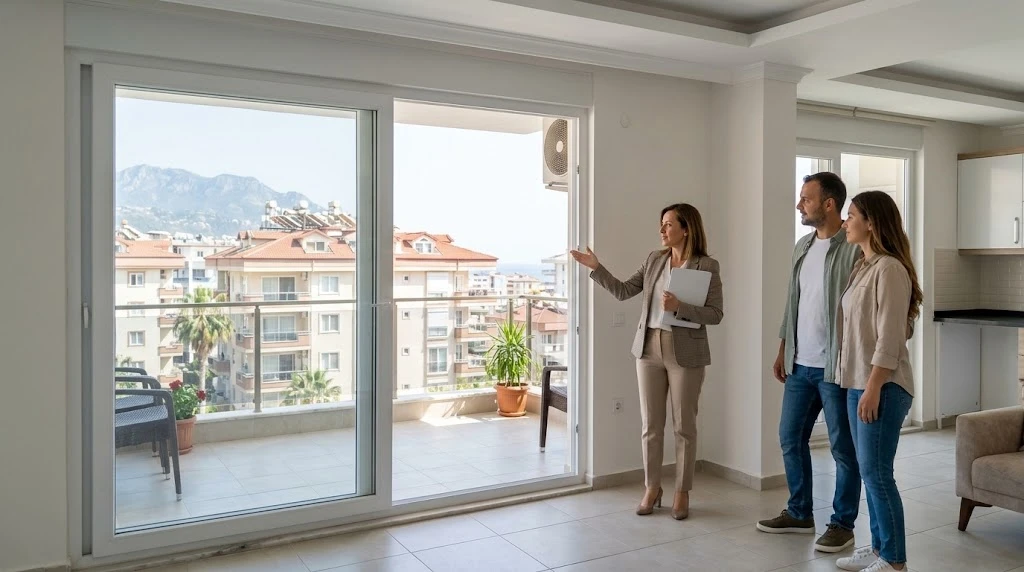
Buying a flat in Alanya usually starts with choosing the type and price, but the risks involved in the transaction lie in the paperwork, the contract and any additional charges. The Ruyana team has put together this checklist for buyers who have already shortlisted a few properties and want to know what to check before making a payment. Below, we outline the roles of the estate agent, an independent solicitor and a technical expert, and explain at which stage it is best to pause the payment process.
A checklist for buying a flat in Alanya should cover the neighbourhood, the seller, the documents, the condition of the property and the full budget. Before paying a deposit, check that the flat matches the property register, and verify any encumbrances, permits and the seller’s authority. For a new-build property, research the developer and the contract separately. Agree in writing on taxes, commission, aidat, additional charges, the refund policy and the handover procedure.
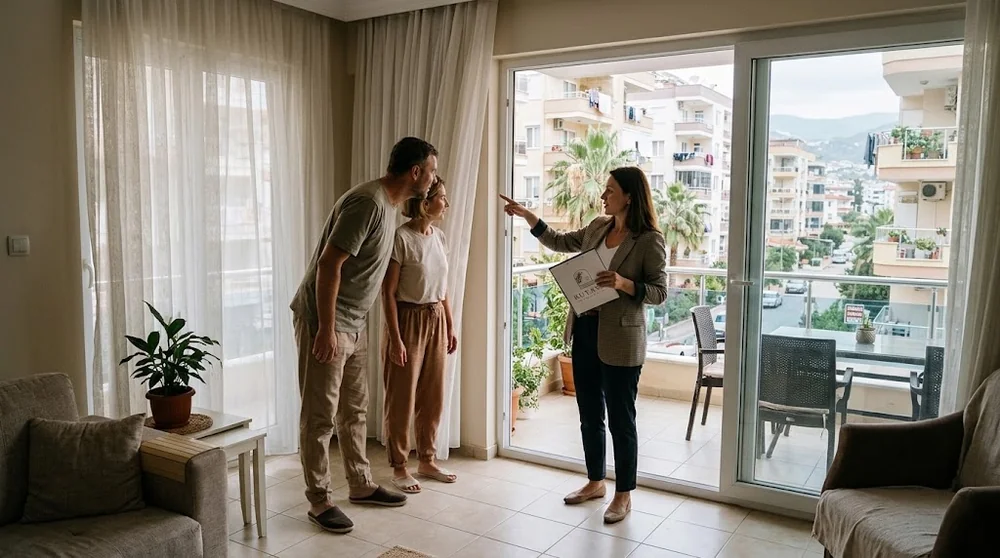
Checklist for buying a flat in Alanya before paying the deposit
The list below stands on its own. Each step produces a specific result, and each step provides a clear basis for suspending payment. The process is as follows:
- Reason for purchase. Result: The purpose of the flat has been recorded in writing – whether it is for permanent residence, seasonal holidays, letting, or an application for a residence permit. Hold: The purpose depends on whether it is for a residence permit or a holiday let, but the conditions for the specific address have not yet been checked.
- A budget with a margin. Result: the maximum total amount, including taxes and charges, has been determined, rather than just the price of the property. Red flag: the seller or estate agent is unable to specify the payee and the basis for each payment.
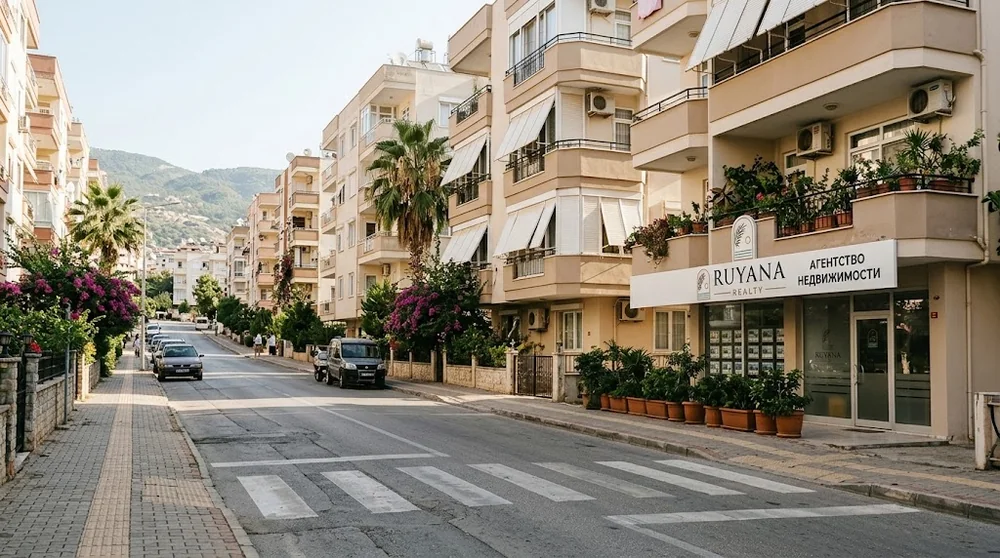
- Directions to a specific address. Result: you’ve walked to the shop, the bus stop, the beach, the school and the doctor’s. Note: your daily route involves either a dangerous crossing of the D400 or a steep climb, which isn’t suitable for you.
- The owner and the seller’s powers. Result: the name in the up-to-date register details matches that of the seller, or their power of attorney has been verified. Stop: the seller is unwilling to produce the documents, or the power of attorney does not authorise the sale.
- Identification of the flat. Result: the province, district, neighbourhood, ADA, parcel, block and independent unit number match in the TAPU, the contract and the plans. Stop: the flat number, floor or floor area differ between the documents.
- Encumbrances and restrictions. Result: the solicitor checked for mortgages, attachment orders, disposal restrictions and other entries. Hold: there is an encumbrance, but the procedure for removing it prior to registration is not specified.
- Building permits. Result: Information has been obtained regarding the building permit (yapı ruhsatı), occupancy permit (iskan) and the form of ownership (kat mülkiyeti or kat irtifakı). Note: There is no occupancy permit, and the reasons for this and the consequences have not been assessed by a lawyer.
- Developer (for a new-build property). Result: the legal entity acting as the seller has been identified, along with its rights to the land and to the specific flat. Stop: they are asking for the money to be transferred to a company that is not a party to the contract.
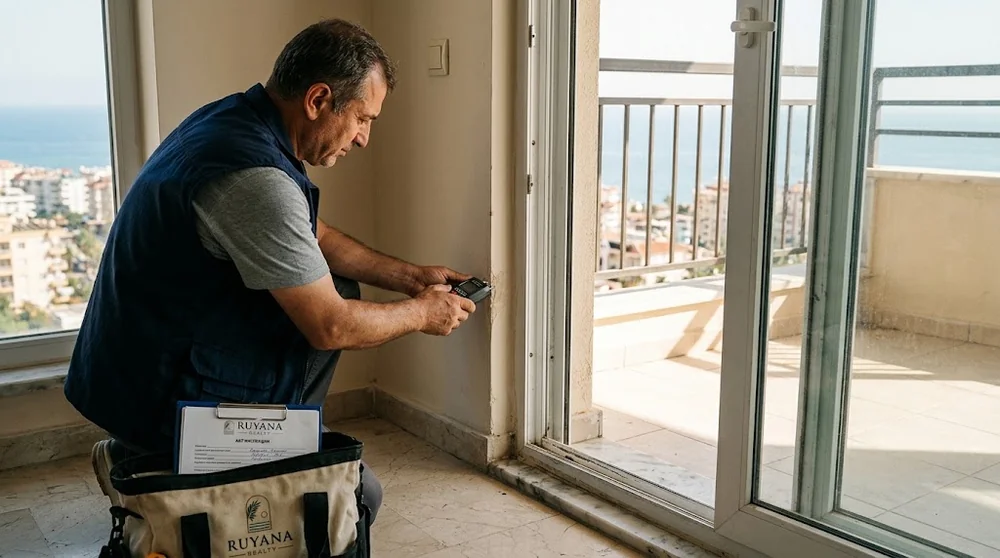
- Technical condition. Result: Humidity levels, windows, electrical installations, building services and communal areas have been checked. Hold: Hidden defects have been found, but the cost or timeframe for rectification has not been agreed.
- Management of the complex. Result: the management plan, the amount of the service charge, details of any outstanding debts and planned works have been obtained. Issue: the management company has not confirmed that there are no outstanding debts relating to the flat.
- Booking or deposit agreement. Outcome: An independent lawyer has reviewed the text, the refund terms and the consequences of either party’s withdrawal. Issue: The contract does not specify in which circumstances a refund is payable.
- Payee. Result: the payment details, currency and payment reference match the seller’s details in the contract. Red flag: the payment details change at the last minute or are only provided via a messaging app.
It is worth distinguishing between the roles of the participants. The agency selects properties, gathers the relevant documents and organises viewings, but it does not replace an independent solicitor. An independent solicitor assesses the seller’s rights, any encumbrances, the contract and the risks involved in the transaction. A technical specialist assesses the condition of the flat and its building services; structural issues and seismic resilience fall within the remit of an engineer. Before paying a deposit, ensure that you have obtained all three of these assessments of the property.
How to check the district and a specific address
Districts of Alanya They differ significantly in terms of terrain, distance from the city centre, seasonality and transport links. A description of the neighbourhood is useful as a guide, but the decision is based on the specific property. Two flats in the same neighbourhood may differ in terms of the street’s gradient, noise levels and the distance to the road crossing. The table below summarises the Ruyana team’s guidelines, rather than guaranteed characteristics of the neighbourhoods.
| District | Accommodation plan | What to check on site | A possible compromise |
|---|---|---|---|
| Alanya town centre | Life without a car, with local amenities close by | Street noise, parking, the age of the building, the condition of the entrance hall | More noise and higher building density, with older housing stock in some parts of the neighbourhood |
| Both | Permanent residence near the city centre | Street gradient, distance to the D400, presence of pavements, view from this floor | Some of the houses are situated on a slope, so the walk to the sea may be longer than expected |
| Tosmur | A quiet residential area not far from Oba | Transport to the centre, the route to the beach, lighting in the evening | Fewer local amenities within walking distance of some homes |
| Mahmutlar | Life in a large neighbourhood with its own infrastructure | Crossing the D400, distance to the sea, density of development, availability of services in winter | The journey to the centre of Alanya takes longer |
| Kestel | A flat by the sea, between the city centre and Mahmutlar | Noise from the motorway, access to the beach, shops within walking distance | Houses by the motorway and those by the ski slope differ significantly in terms of comfort |
| Kargydzhak | A peaceful setting, often with a sea view | Slope, transport without a car, winter opening hours for shops and cafés | Many everyday journeys may require a car |
| Avsallar | A holiday or a quiet life in the western part | Distance to the town and hospital, transport, services outside the peak season | Distance from the centre and a more limited range of services in winter |
We do not publish a price ranking by district because, without a comparable sample based on year of construction, floor level, floor area and the status of the property’s legal documents, such a ranking would be misleading. No single neighbourhood in Alanya is universally the best: the right neighbourhood depends on the buyer’s lifestyle and a thorough check of the specific address.
The route from the flat to the beach and the shop
It’s best to check the location on foot rather than from a car window. Walk the route from the building entrance to the nearest grocery shop, chemist’s, bus stop and beach. Time your walk and take note of the return journey: the walk down to the sea takes a few minutes, but the climb back up in the heat could be a serious challenge for older people and families with pushchairs.
Please assess the crossings over the D400 road separately. The D400 runs along the coast through many parts of Alanya, so getting to the sea often involves crossing it. Check whether there is an overpass or a controlled crossing nearby, as well as a pavement and street lighting. For families with children, find out which school or nursery is actually nearby, and check the route and transport options. If you’re planning to live there permanently, check where the nearest health centre or private clinic is, and how long it takes to get to the public hospital.
Checks in the morning, in the evening and out of season
A morning check reveals traffic conditions that aren’t apparent during the day. Choose a weekday and walk or drive your actual route at the time you would normally leave home: for example, from 7.30 am to 8.30 am for the journey to school or work. Note down the journey time, traffic congestion and any stops, bus frequency, noise levels and whether the pedestrian crossing is operational during rush hour. If your child is walking to school, check the route specifically at the time lessons start.
During the day in high season, many streets seem bustling, but in the evening and during winter, the picture can change. Visit the property after sunset: check the lighting, noise levels from cafés, roads or building sites, and shop opening hours. If you’re planning to live in Alanya all year round, find out which shops, cafés and services are open in winter, whether public transport runs as frequently as usual, and how often rubbish is collected. You can find out more about municipal services from Alanya Belediyesi.
A common mistake we see buyers making is basing their decision on a single day’s viewing during the peak season. We recommend that clients check at least one morning and one evening route in advance and ask residents what life is like in the complex from November to March.
TAPU, the seller and permits: what documents to request
A TAPU (tapu senedi) is a document certifying ownership of property in Turkey, issued by the General Directorate of Land Registry TKGM. The TAPU specifies the owner, the type of title and the property details, including the ‘ada’ (cadastral block), ‘parsel’ (land parcel) and ‘bağımsız bölüm’ (number of the independent unit, i.e. the flat). These numbers are only meaningful when considered alongside the record’s geographical details. Therefore, the full set of details is cross-checked: province (il), district (ilçe), block or settlement (mahalle/köy), ada, parsel, block (if applicable) and bağımsız bölüm. The entry is then cross-referenced against the approved plan and the flat that is actually being shown.
A copy of the TAPU does not replace the current information in the register. The copy reflects the status as at the date of issue; however, a mortgage, a seizure order or a change of ownership may have occurred since then. For this reason, a solicitor checks the current details in the register immediately before the deposit is paid and again before registration.
| Check | Document | Who confirms this? | Stop signal |
|---|---|---|---|
| Owner | Up-to-date information from the TKGM register, the seller’s property details | Independent solicitor | The seller’s name does not match that of the owner in the register |
| Powers of the representative | A notarised power of attorney and its translation | Independent solicitor, notary public | A power of attorney does not confer the right to sell or the right to receive money |
| Identification of the flat | TAPU, project, contract (il, ilçe, mahalle, ada, parsel, block, independent unit) | Lawyer and technical specialist | The flat number, floor or floor area differ in the documents |
| Purpose of the facility | Information from the register regarding the type of property | Independent solicitor | The property is not registered as a residential property, but the buyer plans to live there |
| Encumbrances | The ‘Restrictions’ section of the register details | Independent solicitor | Mortgage, attachment or prohibition without a written authorisation for release |
| Form of law | The term ‘kat mülkiyeti’ or ‘kat irtifakı’ | Independent solicitor | The seller does not explain why the building has not been converted to kat mülkiyeti |
| Planning permission | Building permit | Lawyer, and architect if necessary | The document relates to a different site or a different phase |
| Operating licence | Iskan (building occupancy permit) | Lawyer, local authority details | No search has been carried out, and the reasons have not been established |
The distinction between the different forms of law is important for understanding the status of a building. A ‘Kat irtifakı’ is the right to a future flat in a building that is under construction or has not yet been granted a certificate of occupancy. Kat mülkiyeti is full ownership of a flat in a completed building, which is usually registered after the building permit has been obtained. A ‘yapı ruhsatı’ is a building permit, whilst an ‘iskân’ is a permit authorising the use of a completed building.
The absence of a final inspection certificate requires an investigation into the causes and a legal assessment. The reason may be technical, or it may relate to non-compliance with the building plans, the developer’s debts or unfinished works. The absence of a certificate of occupancy does not automatically mean that the purchase is valid, nor does it automatically mean that the transaction must be cancelled. A solicitor assesses the implications, and where there are questions regarding the building’s compliance with the plans, a technical expert is consulted.
A separate note on self-assessment online. Web Tapu — is the TKGM’s online portal for a range of property-related services. The scope of self-service access depends on the user’s method of identification and their relationship to the property. A buyer who has not yet become the owner will, as a rule, not be able to view the full record for someone else’s flat. Therefore, they obtain up-to-date information via the owner, the owner’s representative or a solicitor, and a screenshot provided by the seller is not considered sufficient proof.
How to check a property developer and a development under construction
When purchasing new-build properties The buyer selects the brand, the sales office and the property renderings. Legally, the buyer enters into a contract with a specific individual and transfers the money to a specific recipient. The purpose of the verification is to trace the chain from the brand name to the legal seller, the land rights, the right to sell the chosen flat and the recipient’s account.
Legal entities and land rights
Start with the full name of the company as stated in the contract. MERSİS is the central electronic company registration system in Turkey, whilst the Türkiye Ticaret Sicili Gazetesi is the official gazette of the commercial register, where company registrations, changes in management and the powers of signatories are published. A lawyer checks whether the company exists, who is authorised to sign contracts on its behalf, and whether these powers have changed.
The next step is to establish who owns the land. In many projects, the land is owned by one person, whilst another person carries out the construction under a contract with the landowner. In such cases, it is necessary to understand which flats under this contract are allocated to the developer and which to the landowner, and whether the seller has the right to dispose of your particular flat.
- Check that the company name is consistent across the contract, advertising and bank details.
- Check the signatory’s authority against the commercial register and powers of attorney.
- Obtain details of the plot owner and the agreement between the landowner and the developer.
- Ensure that the flat you have chosen is owned by the seller and is free of any encumbrances.
- Check that the recipient of the money is the same as the legal seller named in the contract.
- Obtain a building permit specifically for the phase or block in which the flat is situated.
Permits and completed projects
A building permit must relate to a specific plot of land and a specific block. In large developments, phases are built in stages, and a permit for the first phase does not confirm the status of the second. Request the documents relating to your phase and compare the number of storeys and flats with the project plans.
It is worth visiting the developer’s completed projects in person. Take a look at the condition of the façades, communal areas and building services after several years of use, check whether the building has been registered and whether the flats have been transferred to kat mülkiyeti. Talk to the owners about the handover timescales and the quality of the work. Feedback from owners helps to assess quality, but such feedback does not prove the developer’s financial solvency nor does it confirm their right to sell a specific flat.
Contract and Specification
A contract for the sale of a flat under construction must include payment deadlines and instalments, the consequences of late payment, refund terms and conditions, and the following annexes: the floor plan, the finishing specifications and a description of the communal areas. Check whether the handover date is specified as a specific date or merely a vague estimate, and what happens if the deadline is not met.
A lawyer assesses the legal form of the contract separately. For certain types of contracts relating to the future transfer of property, Turkish law may require the contract to be notarised. A simple booking agreement signed at the sales office does not provide sufficient protection for the rights of a buyer of a flat under construction. In the Ruyana team’s experience, it is useful to attach the specification to the contract, along with a list of materials and equipment, rather than simply using the phrase «high-end finish».
Inspection of the flat and review of the management of the estate
The legal status, floor area, condition and management of the estate are all interrelated factors to check. A flat with all its paperwork in order may have leaks, whilst a flat in good condition may be part of an estate with outstanding debts and costly renovation work planned.
Area and condition
In Turkey, floor area is given as ‘net’ and ‘brüt’. Net refers to the usable floor area within a flat. Brüt is a broader measure, but its composition depends on the seller’s or the development’s methodology. You should therefore ask for three figures separately: the net floor area of the flat, the floor area including walls and, if the seller provides it, the floor area including the allocated share of communal areas. Compare flats using only the same measurement criterion, and specify the chosen criterion and measurement method in an annex to the contract. Check the actual layout against the plans: a glazed balcony or an open-plan kitchen may not correspond to the documents.
- Damp and waterproofing: stains by the balcony door, in the corners, in the bathroom and beneath the windows.
- Windows and doors: airtightness, operation of fittings, signs of condensation.
- Electrical installations: condition of the fuse box, sockets, earthing and the load for air-conditioning units.
- Ventilation and air conditioning: operation, drainage, age of the equipment.
- Plumbing: water pressure, boiler or solar collector, signs of leaks from the flat below.
- Lifts, swimming pools and fire exits: operational condition, maintenance, unobstructed escape routes.
- Inventory: the furniture, appliances and curtains that are to remain in the flat are listed in writing.
A visual inspection does not constitute an engineering report, and a DASK policy does not confirm the building’s seismic resistance. DASK is compulsory earthquake insurance for homes in Turkey; the insurance covers certain losses but does not assess the structure. Questions regarding cracks in load-bearing elements, the foundations and compliance with the building plans are referred to an engineer.
Aidat, debts and common areas
Aidat is the monthly contribution made by the owner towards the maintenance of the complex: cleaning, security, the swimming pool, the lift and communal utilities. The yönetim planı is the building management regulations, which set out the allocation of costs, the use of communal areas and the decision-making process. Request a copy of the yönetim planı, the complex’s budget, the minutes of recent meetings, confirmation that there are no outstanding debts on the flat, and details of decisions regarding major works: roof repairs, façade work or lift replacement.
Decisions regarding major works are important for the budget, as one-off contributions are shared amongst the owners. If the owners’ meeting has already approved costly repairs, the contract must specify who is to pay the portion that has already been charged — the seller or the buyer.
Total cost of purchase: taxes and hidden charges
The price of the flat is just the first item in the budget. Every additional amount must have a basis, a payer, a due date and supporting documentation. In the table, we do not include rates that cannot be verified for a specific transaction; amounts are taken from the contract, official rates and invoices as at the date of payment. Please complete the «Amount per property» column together with your solicitor as and when you receive the documents, and treat any blank row as a pending item rather than a zero.
| Position | Base or foundation | Payer | Duration | Total for the project | VAT | Confirmation |
|---|---|---|---|---|---|---|
| Land registry fee | As at October 2026 — 2% from the buyer and 2% from the seller of the declared actual transaction value; the base cannot be lower than the value for property tax purposes (Law No. 492 on Fees, GİB) | The buyer and seller shall specify the allocation in the contract | Before registering with TKGM | ___ TRY | Not applicable | Payment receipt |
| Registration service fee | Official rate as at the date of registration | Under the contract | Before registration | ___ TRY | As stated on the receipt | Receipt |
| The agency’s commission | Brokerage agreement; total limit of 4% excluding VAT for both parties (Antalya Trade Office, as at October 2026) | Under the terms of the contract with the agency | Under the contract | ___ TRY | Charged separately (next line) | Contract and invoice |
| VAT on commission | Charged at the current rate on the commission amount | The party paying the commission | Together with the committee | ___ TRY | That is VAT | Invoice |
| VAT on the supply | Applicability depends on the seller, the property and the buyer’s status | Determined by a solicitor and a tax adviser | Under the contract | ___ TRY | Included in the price / charged separately / not applicable — to be specified in the final agreement | Invoice or written statement |
| Independent solicitor | Service Agreement | Buyer | Under the contract | ___ TRY | Included / charged separately — specify on the invoice | Contract and invoice |
| Sworn translator | Translator’s rate | Buyer | At check-in | ___ TRY | As stated on the receipt | Receipt |
| Notarised power of attorney | Notary fees and translation | If the buyer draws up a power of attorney | Before registration | ___ TRY | As stated on the receipt | Notary’s receipt |
| Valuation | Only if the registration authority or a solicitor has confirmed in writing that the report is required for this transaction | Under the contract | Before registration | ___ TRY | Specify the valuer’s invoice number | Valuator’s report and invoice |
| DASK | The insurer’s premium based on the building’s specifications | Owner | Before or at the time of registration | ___ TRY | Not applicable (insurance premium) | Policy |
| Banking and currency conversion | The bank’s rates and the exchange rate on the date of the transaction | Buyer | On the day of the transfer | ___ TRY | Specify as per the statement | Bank statement |
| Connecting utilities | Water and electricity supplier charges, deposits | New owner | After registration | ___ TRY | Specify in accordance with the contracts | Contracts with suppliers |
| Furniture and appliances | A separate contract or schedule to the main contract | Buyer | Under the contract | ___ TRY | Included / charged separately / not applicable | Inventory and account |
| Aidat and extraordinary contributions | The complex’s budget and the meeting’s decisions | The owner from the date specified in the contract | Monthly and as decided by the meeting | ___ TRY | Specify as per the reference | Certificate from the management company |
| Total costs to the buyer | The total of the completed lines for which the contract holds the buyer liable | Buyer | Before the main translation | ___ TRY | VAT has been accounted for once | A set of receipts, invoices and contracts for each line item |
An illustrative example of calculating tapu harcı. The declared value of the flat in this example is 5,000,000 TRY, and this is not less than the value used for property tax purposes. Each party’s share, calculated at the rate 2%, is 100,000 TRY; the total tax amount is 200,000 TRY. The indicative calculation for the tapu harcı does not represent the full cost of the purchase: it shows only the registration fee. If, under the contract, the buyer assumes the seller’s share, their expenditure on this line will amount to 200,000 TRY. We do not provide the equivalents in euros and US dollars here, as the conversion is only accurate using a verified exchange rate TCMB as at the date of the transaction.
It is convenient to write the formula for the total cost as follows: total cost = contract price + payments that the contract requires the buyer to make + professional services + insurance + bank charges + preparation of the property + aydat and fees payable prior to moving in. To avoid double counting, check three things. If VAT is already included in the price, it should not be added separately. If the commission is paid by the seller, it should not be added to the buyer’s quote. If furniture is included in the price as per the inventory list, do not create a separate line item for it.
A separate note regarding valuation. We do not claim that a valuation report is mandatory for every transaction. Before making any mandatory payment, obtain written confirmation from the registration service or a solicitor as to whether a valuation report is required for your transaction on the date of registration. If one is required, include the cost in the estimate and agree in advance who will commission and pay for it.
Deposit, payments, registration and handover of keys
The transaction goes through five checkpoints. At each checkpoint, the buyer checks specific documents before the money or title is transferred to the next stage. The time taken to complete the paperwork varies from buyer to buyer: it depends on the property’s documentation, the method of payment, powers of attorney and the workload of the relevant services.
- Before booking. The meaning of ‘kapora’ is determined by the wording of the agreement: a kapora may be a deposit, an advance payment or a fee for withdrawing the property from sale, and the consequences of withdrawal differ in each case. Check who receives the money, under what conditions it is refunded, and what timeframe is allowed for verifying the documents.
- Prior to the binding contract. A solicitor checks the contract, any annexes and the legal form. The contract sets out the price, payment schedule, allocation of taxes and fees, the condition of the flat, an inventory and the date of handover. Agree on the payee’s details, the currency and the payment reference; if details are received via a messaging app only, verify them via a second channel.
- Before the main translation. The parties shall agree in writing on the sequence of events: when the principal sum is to be transferred, when the mortgage or other encumbrance is to be discharged, when the registration is to take place, and when the unencumbered flat is to be handed over. For each step, they shall specify who is responsible for confirming completion: the seller’s bank for the removal of the mortgage; the solicitor for the clarity of the entry in the land register; and the seller and buyer for the handover of the flat as per the deed. If any confirmation is not received or the details do not match the contract, the main payment shall be suspended until the discrepancy is resolved.
- Before registration. A solicitor double-checks for any encumbrances in the TKGM register. If there is a mortgage on the flat, the procedure for its discharge is documented in detail: the seller’s bank, the repayment amount, a letter from the bank and the date of discharge. As of October 2026, as a general rule, a Döviz Alım Belgesi is required when a foreign individual purchases property: the currency is sold through a bank to the Central Bank of Turkey, and the certificate issued by the bank is submitted to the registration authority (clarifications from the TKGM). Please check with the bank and an independent solicitor regarding the applicability of any exemptions and the sequence of transactions before transferring the money.
- Upon handover. The transfer of title in the land register, the handover of keys and the vacating of the flat are three separate events. Check that there are no tenants or future bookings, take meter readings, check that the contents match the inventory list, and sign the handover report, including a list of defects.
In the Ruyana team’s experience, most post-purchase disputes relate to the handover: the flat has already been registered in the buyer’s name, but the seller’s belongings remain in the property, there are outstanding utility bills, or there are guests with a booking. A handover certificate, stating the date, meter readings and the signatures of both parties, protects both sides.
Payments must be properly documented. Keep your bank statements, payment references, receipts and invoices. Cash payments make it difficult to prove that payment has been made and may cause complications in the event of future claims relating to the property.
Residence permits and tenancy: specific checks to carry out before buying
The right to buy a flat, the right to apply for a residence permit and the right to let a flat to tourists are three separate matters. Buying a flat in Alanya does not automatically grant a residence permit, nor does it automatically grant the right to let it out to tourists. If one of these objectives is the reason for the purchase, it is checked before the deposit is paid, rather than after registration.
Applications for a residence permit in Turkey are considered by Immigration Service — Migration Management Board. As of October 2026, the Göç İdaresi form for the relevant grounds for a residence permit based on property ownership specifies a requirement for the property value to be at least 200,000 USD, equivalent in Turkish lira at the date of purchase. The applicability of this requirement depends on the date of purchase, transitional provisions and the applicant’s personal circumstances; therefore, this threshold cannot be regarded as a guarantee of obtaining a residence permit. The rules for citizens of the EU, the UK, CIS countries and other states may differ in detail, and the final decision is taken by the competent authority.
The address is checked separately. In Turkey, there are restrictions on the registration of foreign nationals in certain districts and neighbourhoods, and the list of such addresses is subject to change. We do not publish a permanent list of restricted areas in Alanya, as such a list quickly becomes out of date. The status of a specific address is checked on the date of purchase before payment is made, rather than by referring to a list found online.
If the purchase is conditional on a residence permit, it is best to carry out checks on the address, the property’s value and your documents at the same time as the legal due diligence on the flat.
Carrying out this parallel check won’t speed up the decision by the immigration authorities, but it will help ensure you don’t pay a deposit on a flat that isn’t suitable for your purposes.
Holiday lettings are regulated separately Act No. 7464. As of October 2026, if a single tenancy agreement is concluded for a term of 100 days or less, the Ministry of Culture and Tourism applies a permit-based system: a ‘turizm amaçlı kiralama izin belgesi’ — a permit to let accommodation for tourism purposes — is required. This permit must be obtained before the tourist tenancy agreement is concluded, not afterwards. For flats in multi-occupancy buildings, the law generally requires a unanimous decision by all owners of the building in question. The law provides for specific exceptions, and a solicitor will check separately whether these apply to your building before purchase, together with the management plan. Long-term lets and tourist lets are different scenarios with different conditions. Issues relating to citizenship by investment fall outside the scope of this checklist and require a separate consultation.
Frequently asked questions from buyers of flats in Alanya
What should you check before paying a deposit on a flat in Alanya?
Before paying a deposit, you must verify the seller’s ownership and authority, check that the flat matches the registration details, and verify any encumbrances and the building’s documentation. Separately, agree on the full budget, the recipient of the funds and the terms for a refund. If the purchase is dependent on a residence permit or a tenancy agreement, check these conditions in advance. An independent solicitor should review the contract before it is signed.
How can you tell if the Alanya area is suitable for permanent residence?
Check specific locations along your daily route: a shop, a bus stop, a school, a doctor’s surgery and the beach. Walk the route on a weekday morning and in the evening, and assess the crossings over the road, the gradient, the lighting and the noise levels. Check that services are available in winter. The neighbourhood’s reputation is no substitute for inspecting the property itself: two flats in Oba or Mahmutlar may differ significantly in terms of accessibility and comfort.
How can you check a property developer in Alanya before buying a new-build property?
First, identify the legal entity selling the flat, its registration details and the signatory’s authorisation. Then check the land rights, the building permit and the documents relating to the specific phase of the development. Visit completed developments, and examine the contract, the timeframe and the specifications. A brand name, a smart office and positive reviews do not in themselves confirm the right to sell the flat you have chosen.
What additional costs should be added to the price of the flat?
Applicable registration fees, commission, taxes on the specific transaction, legal and translation services, insurance, bank charges and the cost of preparing the property for occupation are added to the price of the flat. A deposit and decisions regarding major works are treated separately. For each amount, ask for the basis, the payer, the payment deadline and the method of VAT calculation: there is no single percentage for additional costs applicable to all flats.
Is it possible to buy a flat without a search?
The absence of a TAPU requires a separate review of the reasons, the building’s documentation and the possible consequences. It is necessary to ascertain whether the property complies with the plans, whether it is possible to obtain planning permission, and who will bear the costs of the necessary procedures. The existence of a TAPU does not answer all these questions. A decision should be made following the opinion of an independent solicitor and, where necessary, a technical expert, rather than on the basis of the seller’s assurances.
Does buying a flat automatically grant you a residence permit and the right to let it to tourists?
Buying a flat does not guarantee a residence permit and does not replace a tourist rental licence. For a residence permit, the relevant requirements regarding the property, its value, address and the applicant are checked. A separate licensing regime applies to letting under a contract for a period of 100 days or less, whilst in a block of flats, as a general rule, a unanimous decision by the owners is required. If these factors are driving your purchase, verify the specific conditions of the property with the relevant authorities and independent specialists before paying a deposit.
Conclusion
The transaction can proceed once the flat’s documents have been cross-checked against the register, the risks have been assessed by a solicitor, the budget and contract have been agreed, the recipient of the funds has been verified, and the sequence of payments and the removal of encumbrances have been documented, and the date and conditions for the handover of the unencumbered flat have been set out in writing. If a key document is missing, the payment will be subject to verification, even if the seller is pressing for a decision. Taking things at a leisurely pace during the verification stage is usually cheaper than having to sort things out after registration.
The Ruyana team works with clients in Russian and English and handles the property search, legal due diligence and residence permit matters separately. We show the client the flat and a list of the documents that have already been obtained for the property, clearly indicating any missing documents.
If you have already decided on your budget and your lifestyle plans, we can put together a selection of flats, complete with a list of the necessary documents and a preliminary cost estimate.
This selection does not replace an independent check, but it helps you to compare options straight away based on the documentation and the total cost, rather than just the price quoted in the advert.
This material is for information purposes only and does not replace an individual legal, tax or technical review. The legal provisions, rates and thresholds are correct as at October 2026 and are subject to change. The decision to purchase depends on the specific property, its documentation and the buyer’s circumstances; please consult an independent specialist in the relevant field before making any payment.
 Property in Georgia
 Property in Montenegro
 Property in Cyprus
 Property in the UAE
 Property in Bali
 Property in Thailand
 Property in Spain
 Property in Saudi Arabia
 Property in Zanzibar
 +90 531 719 64 01
 hello@buy-property-turkey.com
 Summer Park Business Centre, Block 8A, No. 3, 07400 Oba, Alanya/Antalya, Turkey


 Get the catalogue of the top 7 properties